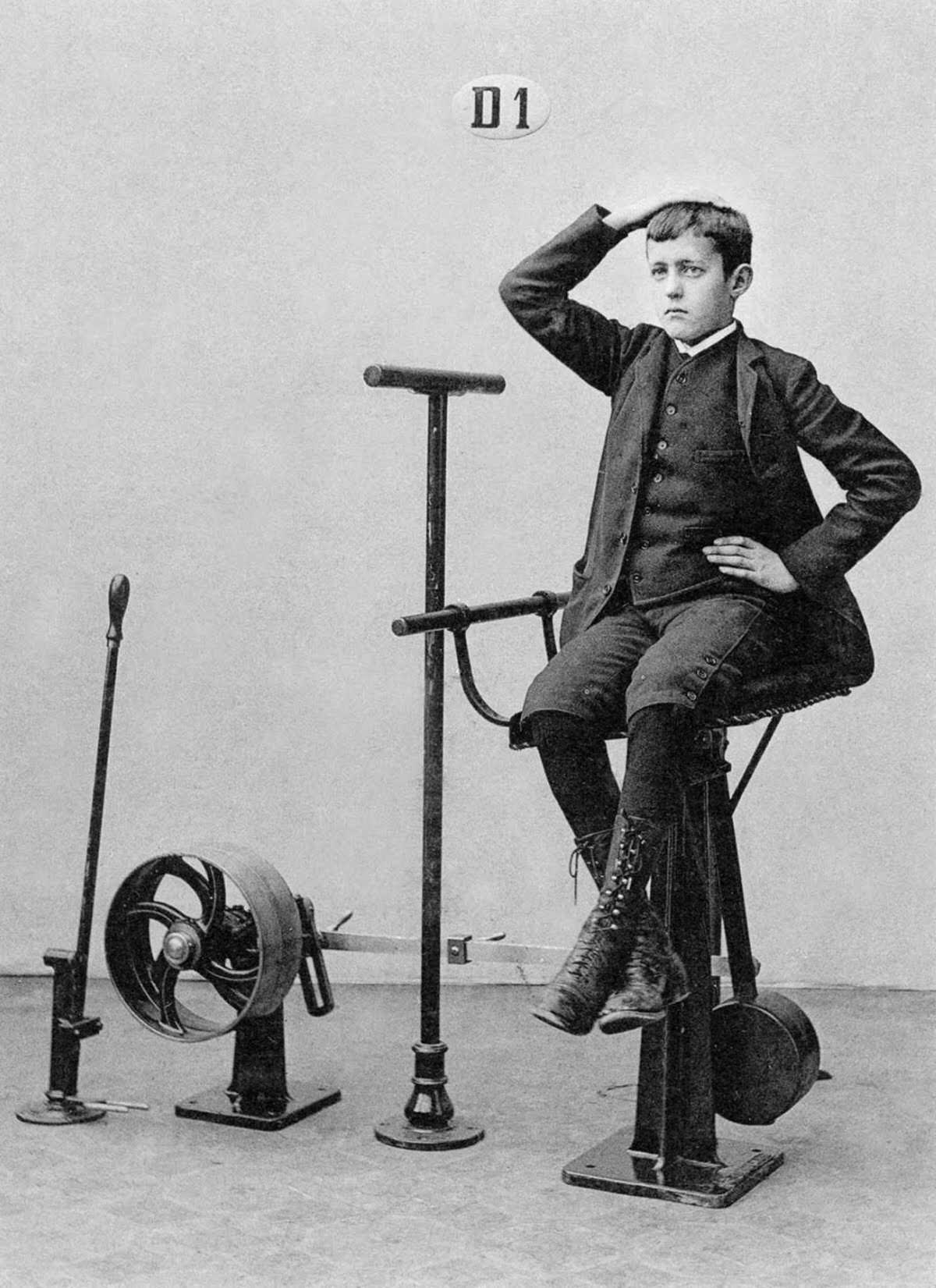
At first glance the seated boy looks as if he’s perched on a simple stool, striking a composed pose in his buttoned suit and high lace-up boots. Then the surrounding hardware comes into focus: a rigid frame, horizontal handles, and a belt-and-wheel mechanism that makes the setup feel more like a workshop apparatus than a chair. Even the plain studio backdrop can’t hide the experiment in motion implied by all that iron and leverage.
The title reveals the trick—this isn’t furniture at all, but a torso-twisting machine intended to strengthen the stomach and midsection. The design suggests controlled rotation against resistance, turning a basic seated position into a guided workout for the core, with the user stabilized while the body is encouraged to twist. It’s a striking reminder that the quest for stronger abs didn’t begin with modern gyms; it arrived earlier through inventive contraptions that borrowed the language of industry and engineering.
For anyone fascinated by old inventions and early fitness equipment, this historical photo captures a moment when health, posture, and “scientific” exercise were being packaged as devices you could operate. The boy’s serious expression adds an almost theatrical tension—part demonstration, part endurance test—making the machine’s promise feel both earnest and slightly uncanny. Look closely and you can see how yesterday’s innovation foreshadows today’s core trainers, while still retaining the peculiar charm of a bygone era of mechanical self-improvement.