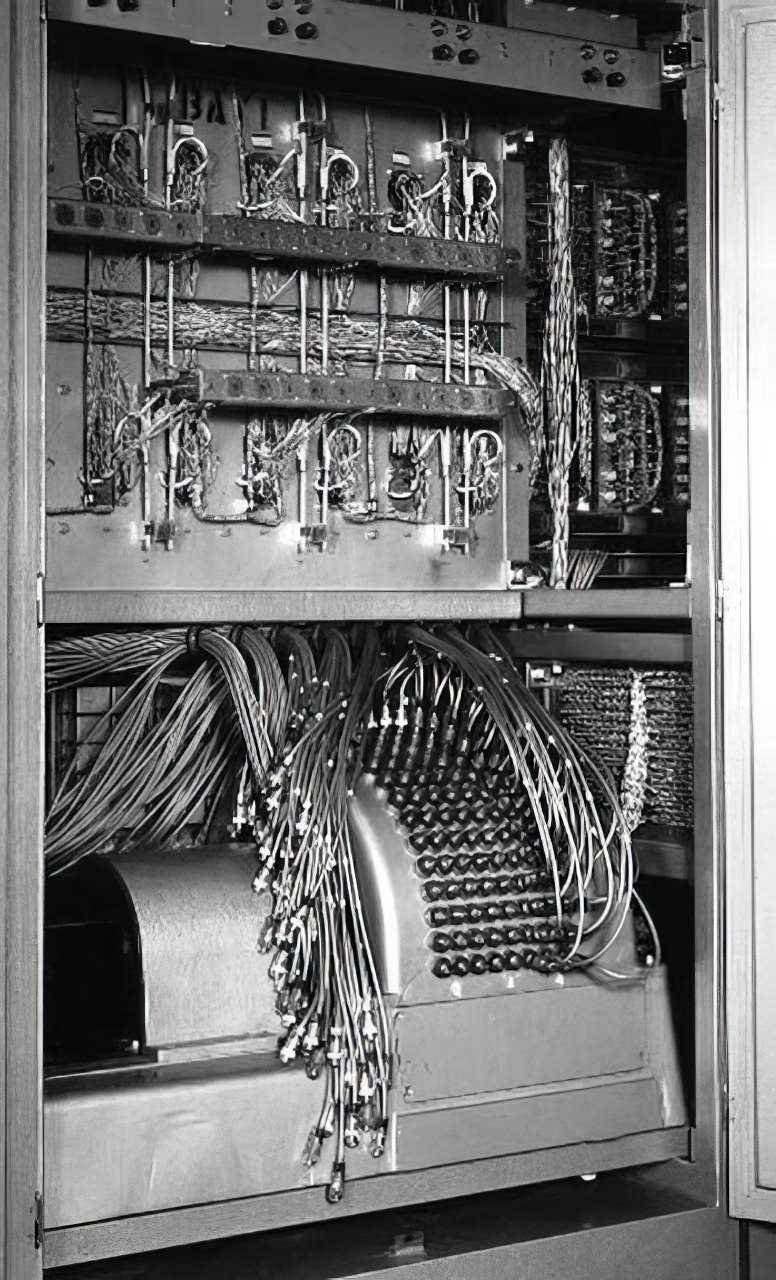
Open cabinet doors reveal the nervous system of an early computer: thick cable bundles drape over plugboards, terminals, and relay-like assemblies, while neatly routed wiring vanishes into stacked panels above. The scene feels half laboratory, half machine shop—an era when computation wasn’t hidden behind sleek cases but laid bare as hardware you could trace by hand. For readers searching the roots of digital technology, this kind of first-generation engineering is the tangible starting point of the computer age.
Inside this dense lattice of connections lies the logic of its time, built from modular components and painstaking manual configuration rather than software menus. Each cord and connector hints at hours of planning, testing, and troubleshooting, reminding us that early computing was as much craftsmanship as science. The photo invites a closer look at how invention happened: not in abstract code, but through physical circuits, switchable pathways, and the disciplined organization of thousands of parts.
Alongside the title, “The Dawn of the Computer Age: A Journey Through the First Generation Inventions,” the image serves as a visual shorthand for the transition from mechanical calculation to electronic and electromechanical systems. It underscores why these pioneering machines were room-filling, maintenance-heavy, and revolutionary all at once—foundations that shaped everything from data processing to modern computing architecture. Whether you’re here for historical photos, early computer hardware, or the story of technological invention, this post follows the wires back to where the future first took form.