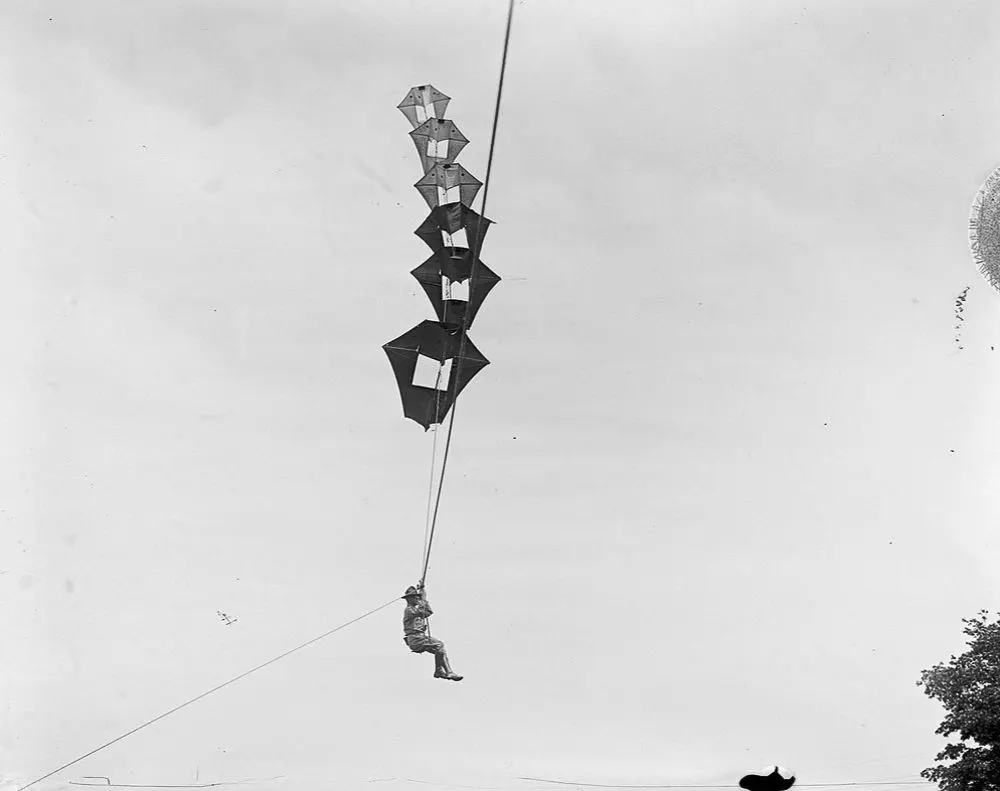
High above an empty stretch of sky, a train of stacked, boxy kites climbs the line like a segmented ladder, each cell adding lift and stability. Suspended beneath them, a lone figure hangs in a harness, legs bent and body braced against the pull—an arresting reminder that “manned flight” once included being hoisted by fabric, spars, and wind. The spare background and taut cables put all attention on the engineering: a modular kite system built to rise steadily and carry real weight.
Before airplanes and drones made aerial observation routine, man-lifting kites offered a practical, if nerve-testing, answer to a timeless military and scientific question: how do you see farther than the horizon? From that elevated perch, an observer could scan terrain, track movement, and relay information back to the ground—early aerial reconnaissance performed with little more than wind and rope. The photograph hints at the careful choreography involved: the main line bearing the load, an angled tether controlling position, and multiple kites sharing the strain.
Curiosity and urgency often drive invention, and this scene sits right at that crossroads of experimentation and necessity. Man-lifting kites were part of a broader story of late-19th and early-20th-century innovation, when engineers tested every path into the air—balloons, gliders, and kite trains—seeking altitude, stability, and control. For readers exploring the incredible history of aerial reconnaissance technology, this image is a vivid gateway into a chapter of aviation history that feels both ingenious and astonishingly daring.