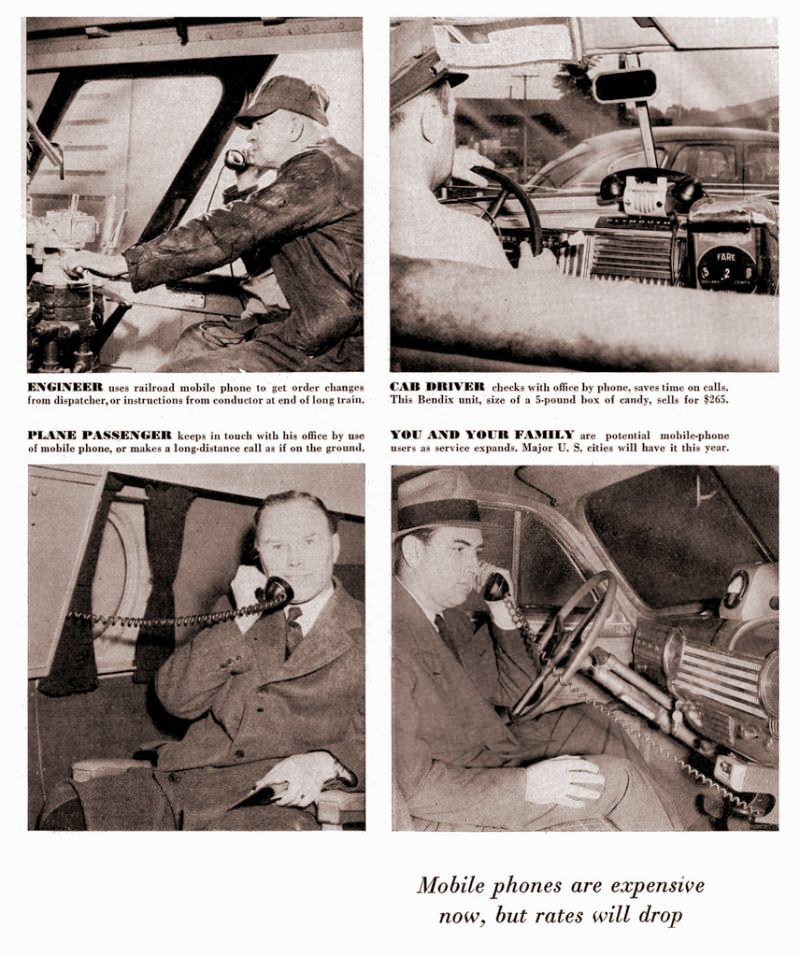
“America Talks,” circa 1947, reads like an early chapter in the story of mobile communication, when making a call on the move still felt like a small miracle. The layout pairs candid, workaday scenes with confident captions, presenting the telephone not as a parlor convenience but as an emerging tool for modern life. Invention and infrastructure meet in these frames, hinting at how postwar America imagined technology smoothing the frictions of distance and time.
Across the panels, a railroad engineer uses a handset in the cab, a car driver checks in by phone, and an airline passenger talks from his seat—each vignette underscoring the same promise: reach anyone, from anywhere. Bulky equipment sits beside dashboards and control panels, cords and microphones emphasizing that “mobile” once meant hardware you could hardly ignore. The captions even point to cost and scale, noting the handset’s size and price and suggesting that service expansion would soon bring the idea within reach of more users.
What makes this historical photo especially compelling is its blend of optimism and practicality, a reminder that today’s effortless calling grew out of incremental experiments and specialized networks. The page openly acknowledges that mobile phones are expensive “now,” while predicting that rates will drop—an argument still familiar in every new wave of consumer tech. For readers interested in inventions, telecommunications history, or the roots of the cellphone era, this 1940s snapshot offers a vivid, SEO-friendly glimpse of America learning to talk on the go.