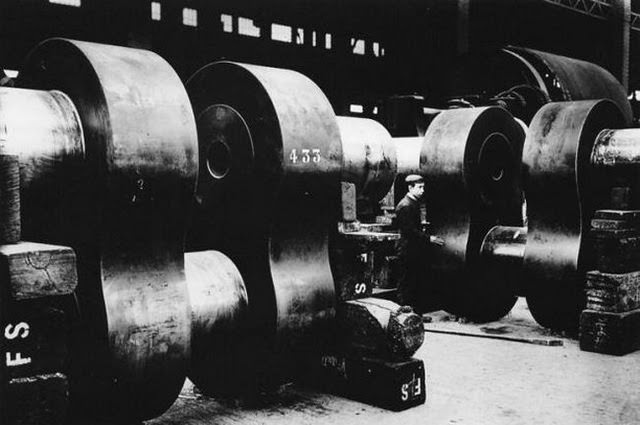
Massive steel shafts and machined cylinders dominate the workshop floor, their polished faces catching the light while a lone worker stands dwarfed between them. The scale is the first lesson: building the Titanic was never just about elegant decks and grand staircases, but about industrial muscle—components forged, turned, and fitted with tolerances that had to hold under relentless stress. In a shipyard environment like this, “unsinkable” was as much a product of engineering confidence as it was a marketing promise.
Inside these cavernous spaces, the story of Titanic’s construction becomes a story of inventions and process—heavy tooling, precision measurement, and the choreography of labor that made complex machinery behave as one. Each numbered piece suggests a system in progress, where power would be transmitted through rotating metal and controlled through careful assembly rather than chance. For readers interested in maritime history, this kind of historical photo offers a rare look at the industrial backbone behind early 20th-century ocean liners.
Public fascination with Titanic often begins with its tragedy, yet its rise to fame started earlier, in factories and fitting shops where sheer size met new manufacturing methods. Details like the stacked components, the grime of the floor, and the hard geometry of unfinished parts ground the legend in practical reality: a modern ship built from countless decisions, tools, and innovations. For a WordPress post focused on Titanic construction history, this image supports the SEO story of shipbuilding technology, industrial heritage, and the engineering mindset that helped create a floating icon.