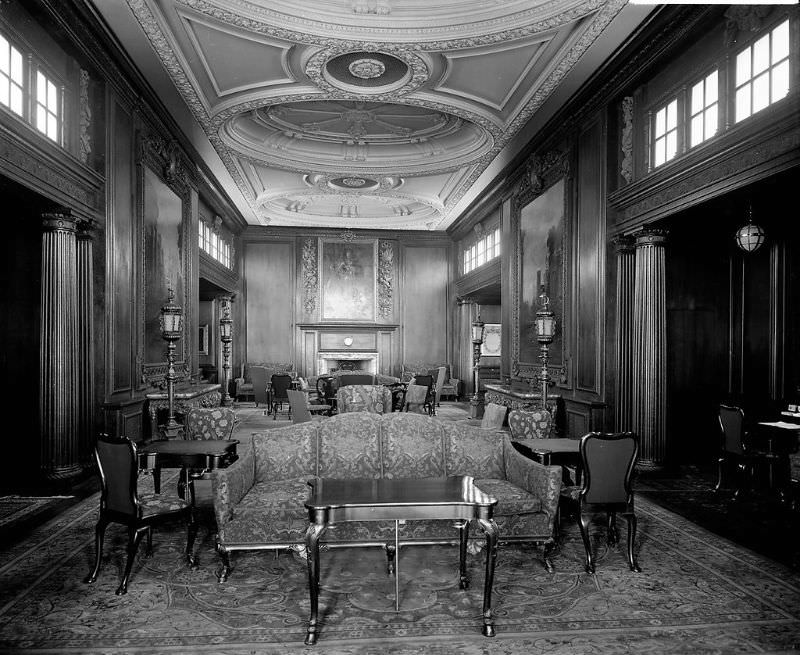
Stepping into Aquitania’s 1st Class Smoking Room, also known as the Carolean Smoking Room, you immediately sense how ocean travel was sold as a complete world of comfort rather than mere transportation. The long, symmetrical space draws the eye toward a central fireplace, while tall paneling and paired columns create the feeling of a private club transplanted onto the Promenade Deck (A Deck). Overhead, an elaborate ceiling with ornate medallions reinforces the room’s ceremonial grandeur, framing the lounge as one of the ship’s signature interiors.
Furniture is arranged for conversation and quiet retreat: upholstered sofas, carved chairs, small tables, and a broad carpet that softens both footsteps and sound. Light filters in from high windows along both sides, revealing polished wood surfaces and framed wall art that turn the room into a gallery as much as a gathering place. Even without passengers present, the layout suggests the rituals the space was built for—reading, debate, and the slow, sociable pace of first-class leisure.
Photographs like this serve as a valuable record of early 20th-century liner design, when engineering achievements were paired with carefully staged luxury to justify the price of a transatlantic ticket. The Smoking Room’s refined decoration—formal, masculine, and club-like—speaks to the era’s social divisions and onboard etiquette, preserved here in striking detail. For anyone researching Aquitania, Cunard interiors, or Edwardian ocean liner life, this view of the Promenade Deck lounge offers an evocative snapshot of what “first class” meant in May 1914.