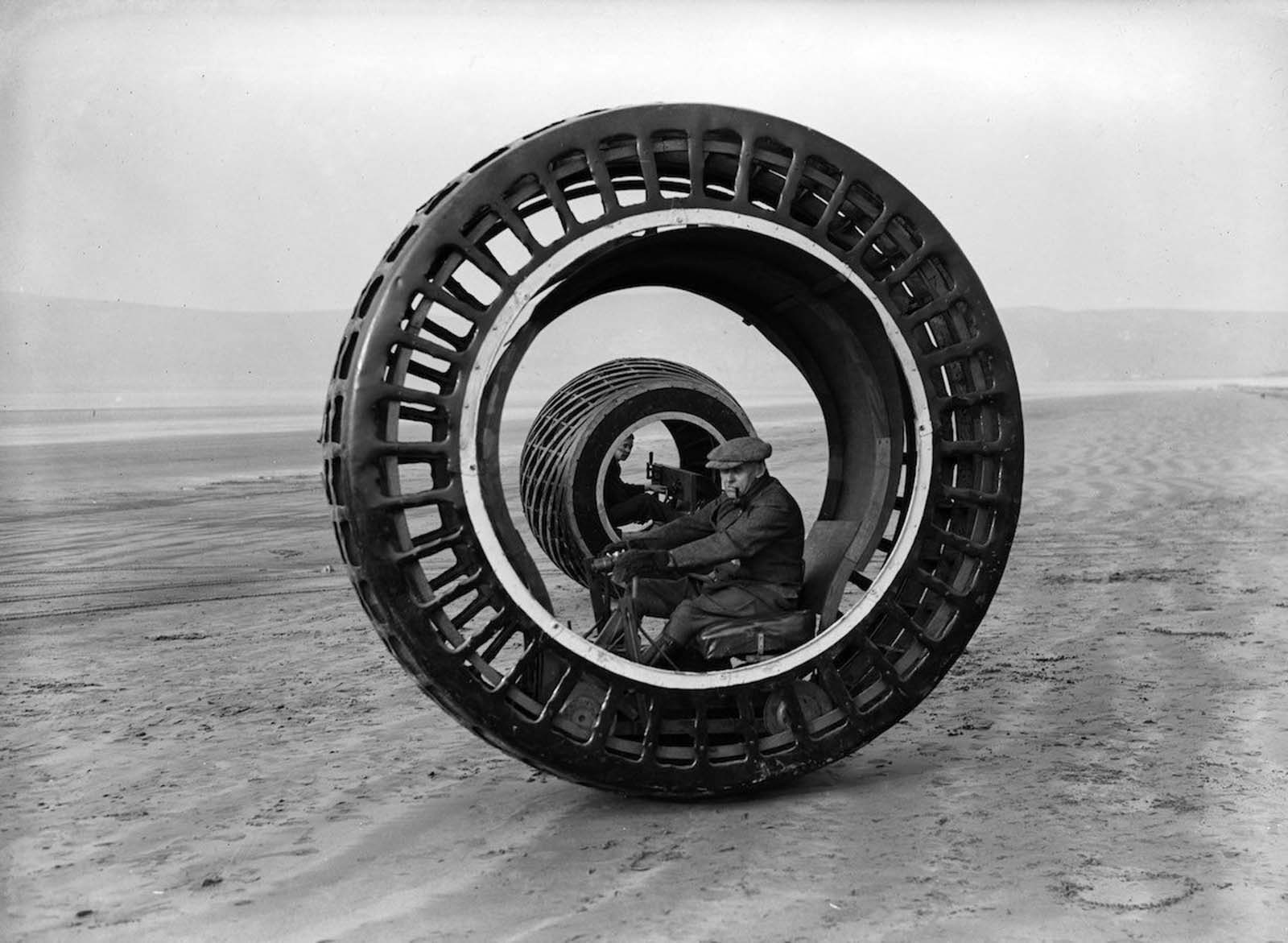
Against the wide, flat sands of Bream Sands at Weston-super-Mare, a startling piece of early 20th-century engineering sits like a giant ring dropped onto the beach. The photograph centres on an “electronically driven” wheel system, its perforated outer rim towering over the seated driver positioned inside the circular frame. With the sea haze and distant shoreline held in soft focus, the inventors’ experiment becomes the unmistakable subject: mobility reimagined as a rotating shell around a stationary operator.
Look closer and the design reads as both practical trial and bold spectacle, the kind of invention that feels perfectly at home in 1932’s culture of mechanical optimism. The driver grips controls from a compact seat while the wheel’s structure suggests internal components meant to power rotation without the rider turning with it. Sand underfoot provides a natural test track, revealing how such a concept might cope with loose terrain and offering a clear, open space where observers could judge speed, stability, and steering in real conditions.
Inventions like this hint at a period when new electrical systems and unconventional vehicle designs promised to rewrite everyday transport, even if many prototypes never progressed beyond demonstration. The image speaks to the experimental spirit of interwar Britain: engineers taking big ideas out of workshops and onto beaches, chasing smoother travel and novel mechanics. For readers interested in transport history, British innovation, or early electric-driven concepts, this photograph offers a memorable glimpse of ambition set against the timeless backdrop of Somerset’s sands.