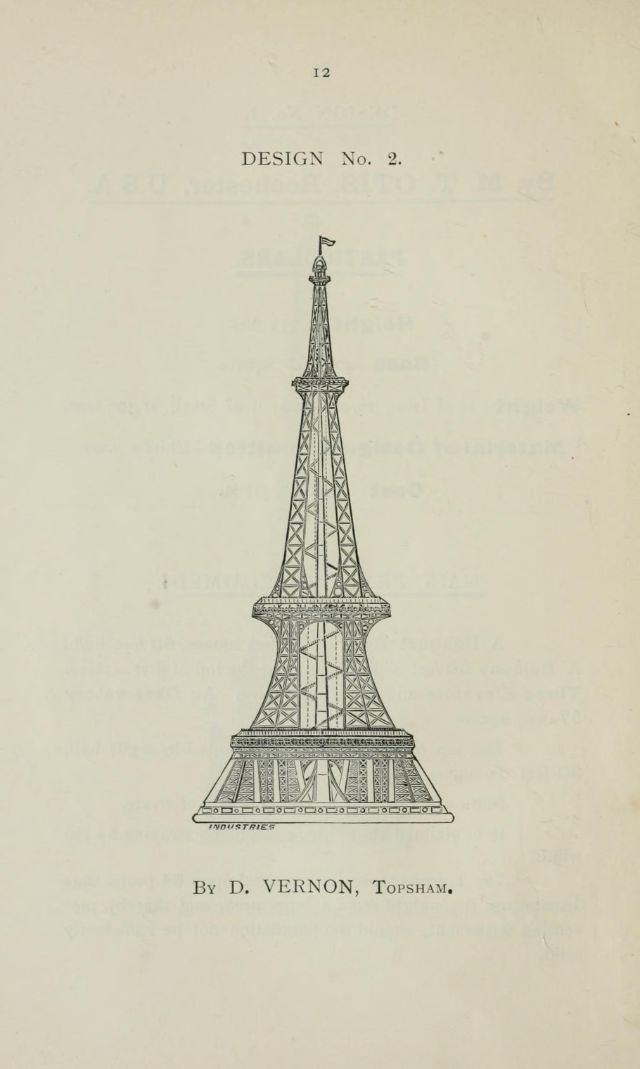
Ambition rises off the page in “Design No. 2,” a crisp line drawing proposing a Great Tower for London, part of the burst of invention and rivalry that surrounded the 1890 competition. The structure is rendered as a slender, lattice-built monument, tapering to a small flag at the summit and anchored by a broad, platform-like base. Fine cross-bracing and layered galleries suggest an engineer’s confidence in ironwork and modern construction, echoing the era’s fascination with height, spectacle, and civic prestige.
Look closely and the draftsmanship reads like a sales pitch in ink: strong verticals, repeating geometric patterns, and a pronounced mid-level deck that would have framed views and movement. The base is labeled “INDUSTRIES,” hinting that the tower was imagined not only as a landmark but as a showcase—part exhibition, part advertisement for technological progress. Even without scenery or surrounding context, the composition emphasizes stability below and daring ascent above, a visual argument for why this design deserved attention among dozens of submissions.
Printed with the credit “By D. Vernon, Topsham,” the sheet also preserves the human side of these grand proposals—individual designers sending their best ideas into a crowded field. Posts like this one offer a window into Victorian-era architectural competitions, when London’s skyline was a canvas for bold schemes and public imagination. For readers searching “Great Tower for London 1890 designs” or “Victorian tower competition drawings,” this image captures the inventive energy of the period in a single, meticulous page.