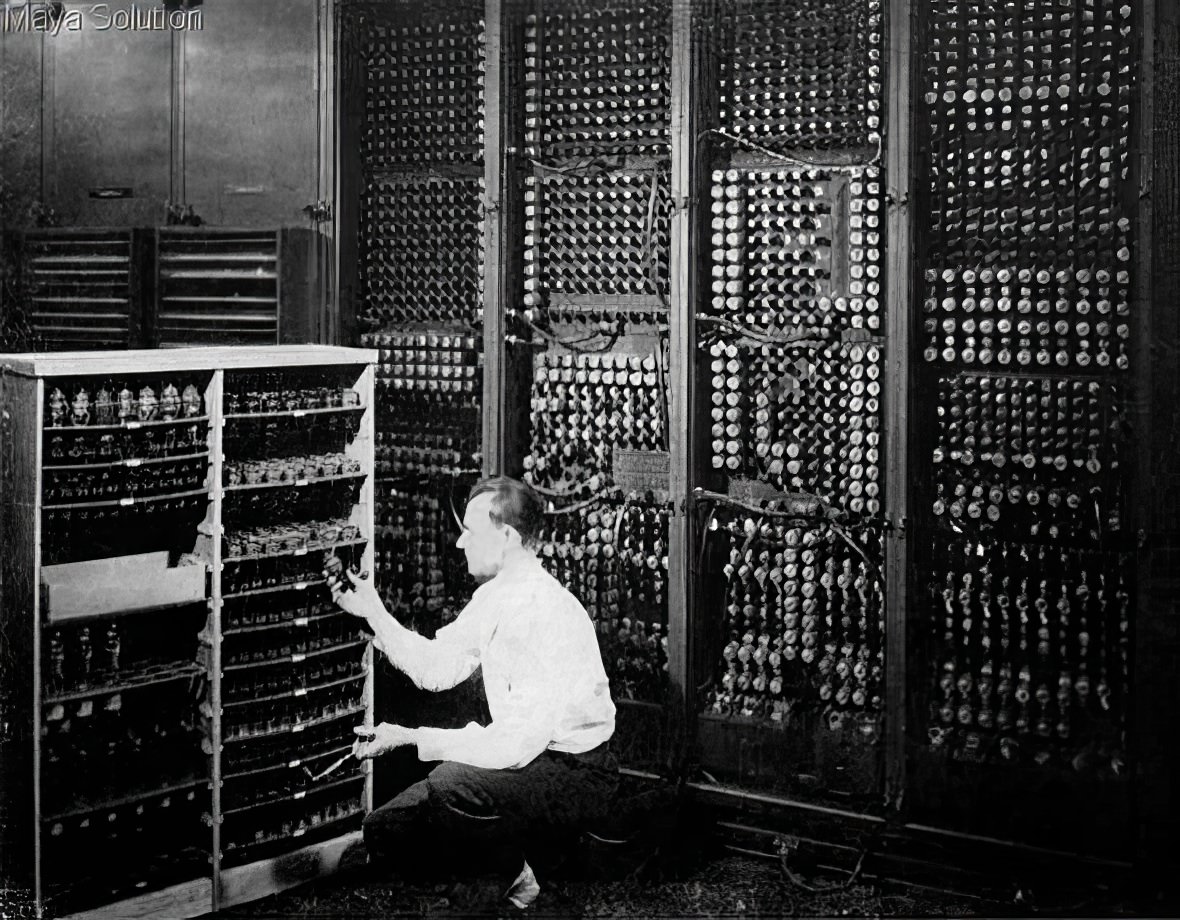
Rows of dials, sockets, and wiring loom like a mechanical wall behind a technician crouched at a bank of electronics, hand poised as if tuning an instrument. The scene conveys the sheer physical presence of early computing—cabinet-sized panels packed with components, where “processing” was something you could almost hear and feel. In the midst of those towering racks, human scale becomes the measure of the machine’s ambition.
On February 1, 1946, the University of Pennsylvania hosted a press conference unveiling the Electronic Numerical Integrator and Calculator (ENIAC), often described as the first computer in the modern imagination. The photograph’s dense circuitry and modular frames hint at what reporters and visitors encountered: not a sleek device, but an engineered environment built from thousands of parts and maintained by careful hands. It was an inventions moment in the truest sense, when complex research hardware stepped into public view.
Today, this historical image reads like a bridge between eras—between wartime engineering and the digital world that followed, between manual adjustment and automated calculation. The ENIAC press event helped shape how the public pictured computing at its birth: vast, intricate, and collaborative, demanding both technical expertise and constant attention. For readers exploring the origins of computers, the photo offers an unforgettable reminder that the first breakthroughs arrived not in pockets, but in rooms.