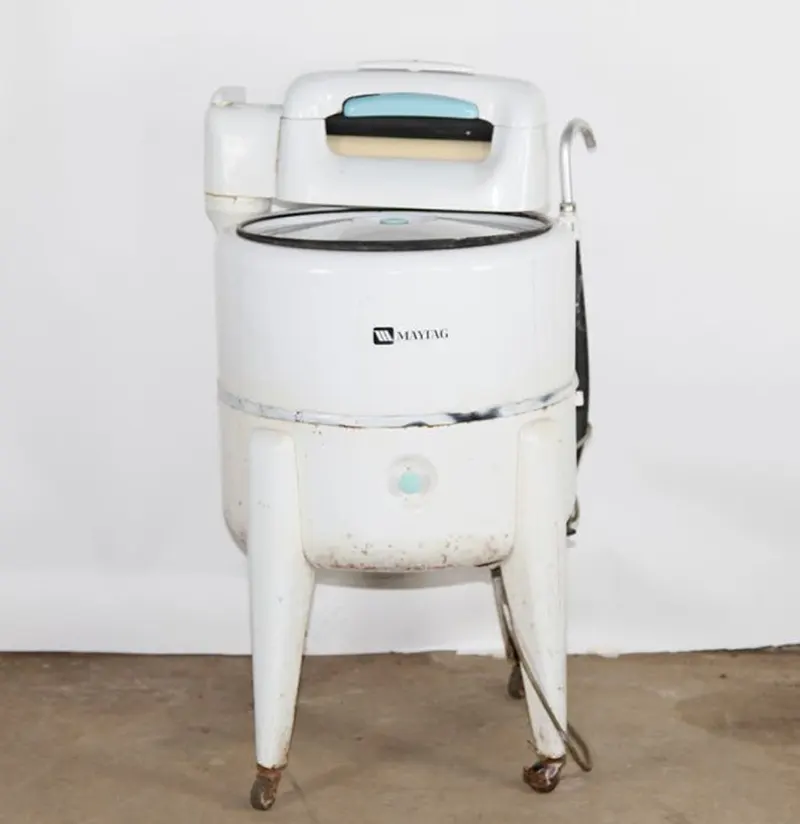
Standing on spindly legs with small casters, the Maytag wringer washer in this 1940-era view looks like a compact workhorse built for a laundry day that demanded muscle and patience. The rounded tub, sturdy enamel body, and the unmistakable Maytag badge signal an appliance made to live in basements, washrooms, and back porches, where utility mattered more than ornament. Even in a simple studio-like setting, the machine’s practical design feels immediate: a container for suds, a place for churned linens, and a promise of cleaner clothes with less hand-scrubbing.
At the top sits the wringer assembly—the defining feature of this kind of washing machine—designed to press water from fabric by feeding it between rollers. That step, perched right on the washer, helped shorten drying time and reduce the heavy lifting of wringing by hand, though it also demanded care and attention in use. The smooth lid and minimal controls reflect a period when “inventions” often meant reliable mechanics and durable materials rather than electronics, and when a household appliance’s main selling point was how much labor it could remove from the weekly routine.
For anyone interested in vintage appliances, home economics history, or the evolution of Maytag washing machines, this photo offers a crisp glimpse into mid-century domestic technology. The wear on the lower body and feet hints at years of service, reminding us that these machines were not decorative curiosities but everyday tools. From a modern perspective—surrounded by automatic cycles and hidden sensors—the wringer washer stands as a clear marker of how far laundry technology has traveled, and how central such inventions were to reshaping work in the home.