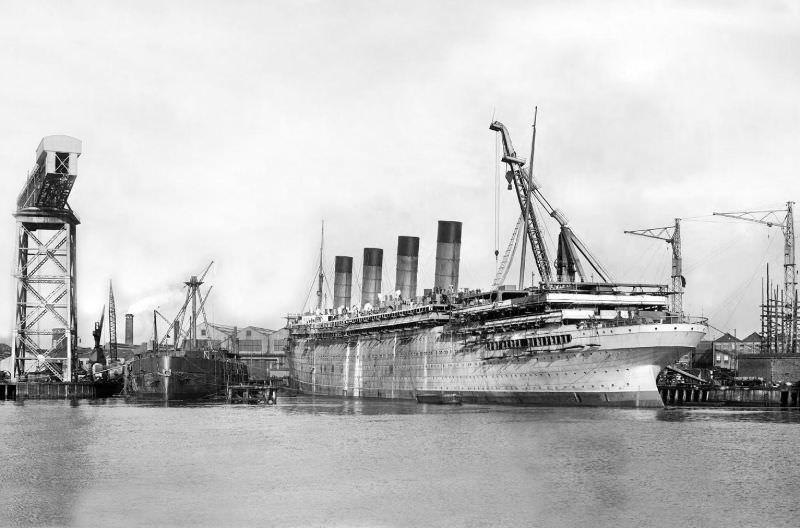
Aquitania sits high in the water of John Brown’s fitting-out basin, her long hull still wearing the unfinished look of a ship between stages of creation. Four great funnels rise in a clean line above the superstructure, while cranes lean over the decks as if still adjusting the last details. Along the quayside, the basin reads like a working diagram of early twentieth-century shipbuilding—masts, derricks, and industrial sheds gathered tightly around a vessel built to dominate the open ocean.
Attention drifts to the textures: the pale plating along the bow, the rows of portholes and openings awaiting their final fittings, and the busy rigging that hints at ongoing work out of frame. The calm surface of the water makes a reflective foreground, emphasizing the ship’s scale and the controlled environment of the yard. Even without close-up detail, the scene conveys a transitional moment when an ocean liner is not yet a passenger world, but a massive engineering project being brought to life piece by piece.
Early 1914 hangs over this view with particular weight, placing the liner’s final preparations at the edge of a changing era. For readers interested in Aquitania, John Brown & Company, and the wider story of Clydebank shipyards and transatlantic liner history, the photograph offers more than a profile shot—it’s a portrait of industry at full stretch. It also pairs neatly with the theme of “Inventions,” capturing the practical ingenuity of cranes, docks, and coordinated labor that made ships of this scale possible.