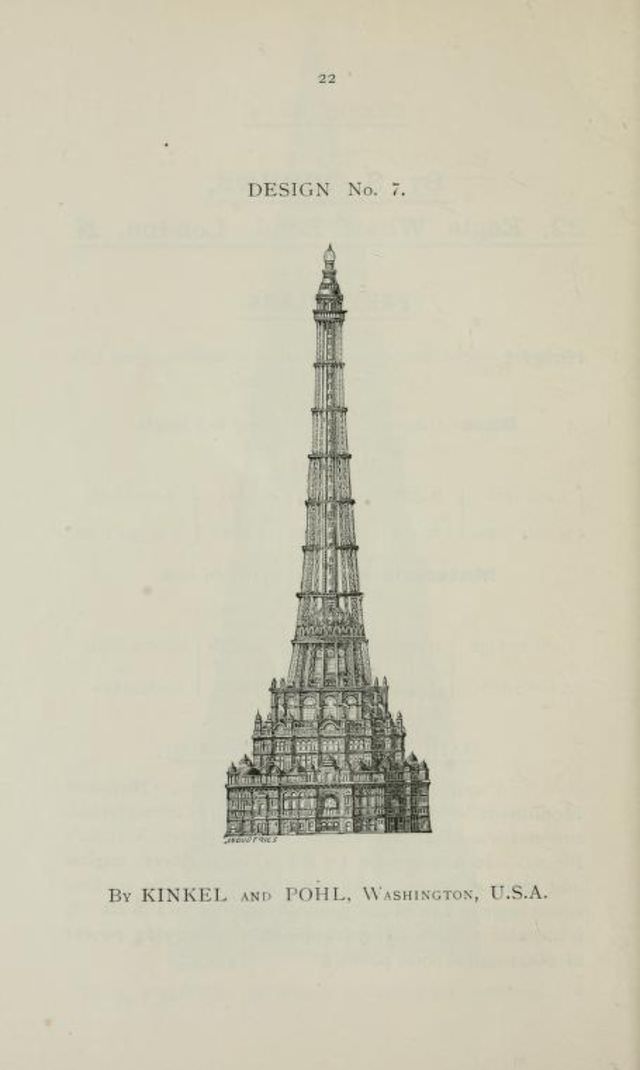
“Design No. 7” sits on the page like a manifesto for height, its slender shaft rising from a heavily ornamented base into a needle-like crown. The drawing is presented with the neat, matter-of-fact typography of an official competition plate, pairing meticulous linework with wide margins that let the proposed Great Tower dominate the viewer’s attention. Beneath the illustration, the credit reads “By Kinkel and Pohl, Washington, U.S.A.,” a reminder that London’s late-19th-century ambition attracted ideas from well beyond Britain.
Gothic impulses and industrial confidence mingle in the architecture: stacked stages, repeating vertical ribs, and layers of arched detailing suggest a monument meant to be read from street level all the way to the skyline. The broad, fortress-like lower section feels designed to anchor the structure visually as much as structurally, while the upper tiers taper in a disciplined rhythm, emphasizing elevation and engineering daring. Even without a surrounding cityscape, the composition implies spectacle—an attraction meant to compete for attention in an era fascinated by grand projects and new inventions.
More than 50 competitive designs were reportedly submitted for the construction of a “Great Tower for London” in 1890, and this plate offers a window into that imaginative race. As a historical document, it speaks to the culture of architectural competitions, where proposals were cataloged, numbered, and circulated as much for public intrigue as for practical decision-making. For readers searching Victorian London history, Great Tower competition designs, or nineteenth-century invention-era architecture, this image preserves the moment when aspiration was drafted in ink and measured in vertical lines.