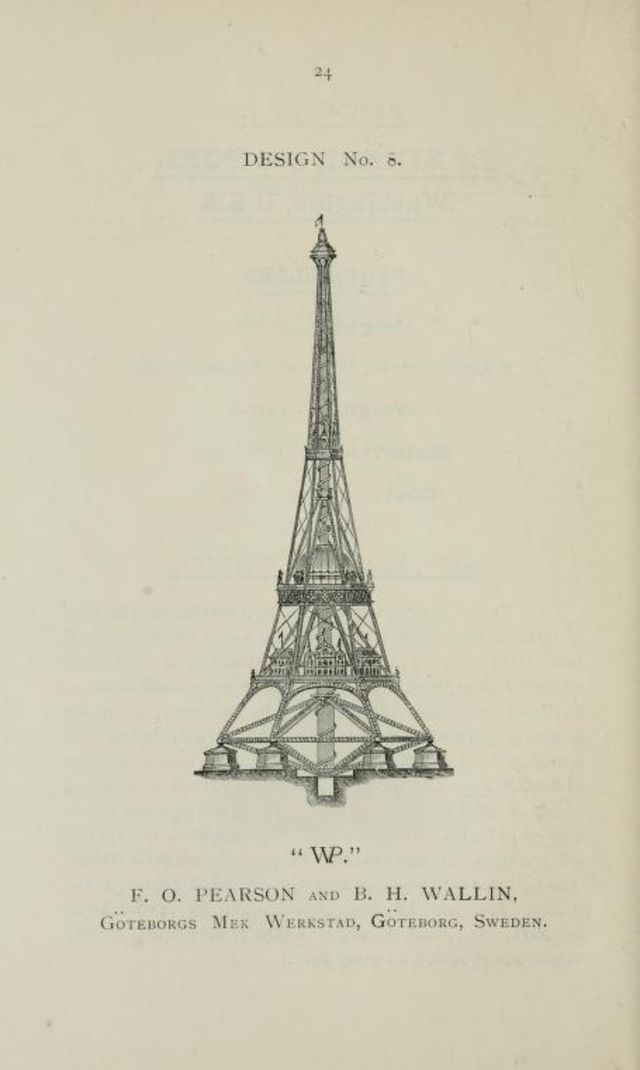
Rising from a clean, uncluttered page, “DESIGN No. 5” proposes a needle-like iron tower crowned with a small finial and anchored by broad, arched supports. The draftsmanship favors clarity over ornament, letting latticework, platforms, and structural bracing speak for themselves—an engineer’s vision of elegance built from trusses and riveted geometry.
In the context of the 1890 push for a “Great Tower for London,” this sheet is a reminder that the famous idea inspired a flood of competitive designs, each trying to balance spectacle with practicality. The layout reads like a patent-era pitch: a tall central shaft, a pronounced midsection with galleries, and a wide base meant to convey stability, all rendered with the confidence of late‑Victorian invention culture.
At the bottom, the credit line points beyond Britain, naming F. O. Pearson and B. H. Wallin of Göteborg, Sweden, underlining how international the competition became. For readers exploring historic architecture, engineering history, and London’s unrealized landmarks, this scanned proposal offers a fascinating glimpse of what might have reshaped the skyline—one of many ambitious submissions in a race to build the era’s next great tower.