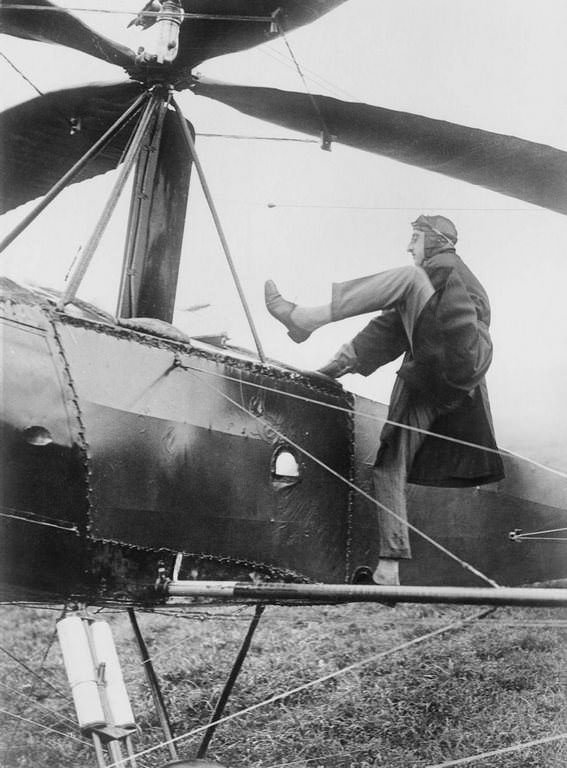
Boot braced on the fuselage, Captain Frank Courtney climbs aboard an autogyro for a test flight in 1925, dressed for wind and weather in a heavy coat and flying cap. Above him, the broad rotor blades dominate the frame, their hub and struts forming a web of early engineering that looks both improvised and daring. The low angle emphasizes the machine’s size and the pilot’s calm, matter-of-fact approach to something still experimental.
What draws the eye is the autogyro’s distinctive silhouette: a compact body, exposed framework, and tensioned cables that hint at the practical realities of pioneering aviation. Unlike the sleek airplane profiles that would later define popular memory of flight, this craft feels transitional—part aircraft, part mechanical contraption—built to test how a rotating wing could change takeoff, stability, and control. The grass undercarriage and open surroundings suggest a field-testing environment where innovation happened in plain view.
For readers interested in inventions and early rotary-wing history, this photograph offers a vivid snapshot of the trial-and-error era that led toward modern helicopter technology. It captures the human side of aeronautical progress: a pilot stepping into the unknown with routine confidence, trusting metal, fabric, and mathematics to do what few had proven before. As a piece of 1920s aviation history, it’s a reminder that breakthroughs often begin with a single climb into an unproven machine.