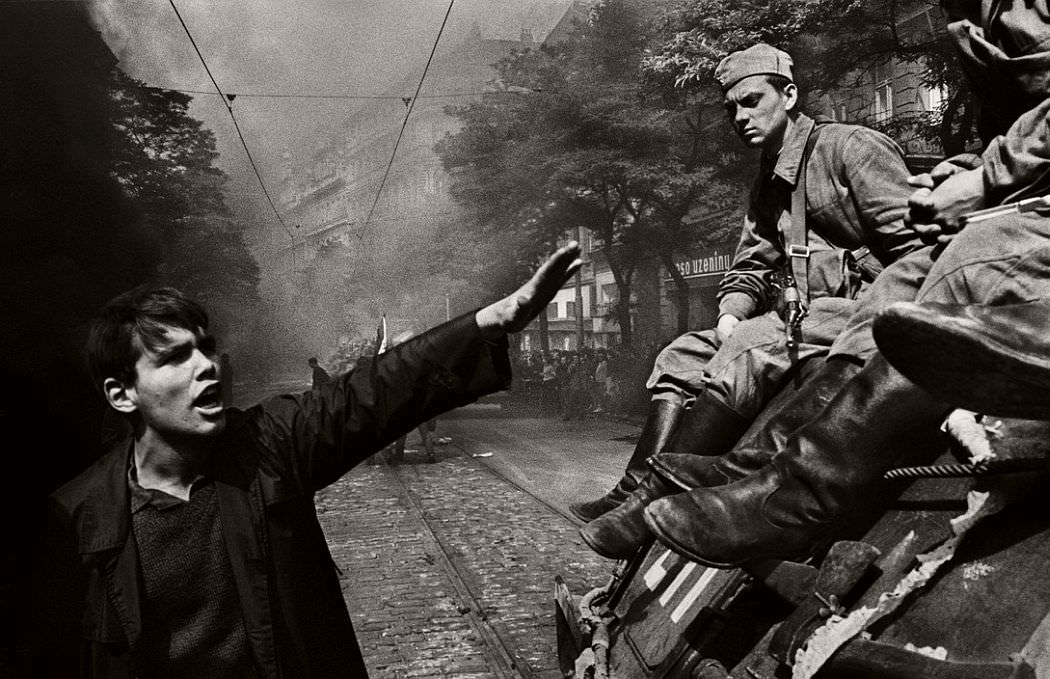
Anger and disbelief spill into the street as a young civilian raises his arm toward a soldier perched on an armored vehicle, the two locked in a tense, unequal exchange. Smoke hangs over the cobblestones and tram lines, turning an ordinary urban avenue into a corridor of occupation. The soldier’s rigid posture and heavy boots contrast sharply with the civilian’s open gesture, a visual shorthand for the sudden collapse of hope that accompanied the Soviet invasion of Czechoslovakia in 1968.
In the background, blurred figures and scattered movement suggest a city trying to understand what is happening in real time—people gathering, retreating, arguing, watching. The armored presence dominates the frame, while the crowd remains partly swallowed by haze, echoing how public life was forced into uncertainty as the Prague Spring was crushed. Details like streetcar wires and storefront signs place the confrontation in everyday space, underscoring how political decisions land hardest on ordinary streets.
Seen today, the photograph reads as more than a battle scene; it is a record of civil resistance meeting military power at close range. The moment captures the emotional geography of 1968—defiance, fear, and the insistence on being heard even when the outcome is bleak. For readers searching for history of the Prague Spring, Soviet intervention, and the lived experience of occupation in Czechoslovakia, this image offers a stark, human-scale doorway into the era’s Cold War drama.