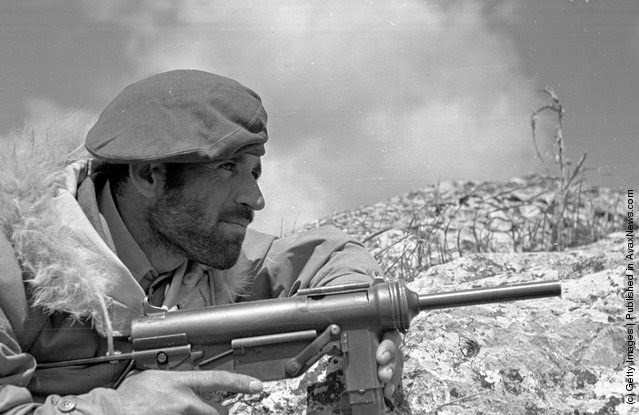
Half-hidden behind rough ground and scrub, a Greek commando keeps low with his weapon braced and his gaze fixed on a point beyond the frame. The fur-collared jacket noted in the title reads as both protection against the elements and a clue to the wider currents shaping the Greek Civil War, when foreign-supplied kit mingled with local improvisation. Dusty textures, hard light, and the soldier’s tense stillness convey the long minutes of waiting that so often defined combat.
Along the barrel and across his face, the photograph emphasizes vigilance more than action, turning a fleeting tactical moment into a study of pressure and resolve. The close viewpoint brings viewers into the immediacy of guerrilla warfare—terrain used as cover, silence as strategy, and uncertainty as a constant companion. Details like the beret, heavy jacket, and the tight grip on the firearm anchor this as a grounded wartime scene rather than a staged tableau.
Set in 1948, this image offers a stark window into a conflict that reshaped Greece and echoed the emerging Cold War, where alliances and aid influenced what fighters wore and carried in the field. For readers searching the Greek Civil War, Greek commando soldiers, or American-supplied equipment in postwar Europe, the photo underscores how global politics translated into the intimate realities of patrols and ambushes. It’s a reminder that history often turns on moments of quiet watchfulness—one soldier, one hillside, and the possibility of sudden violence just beyond sight.