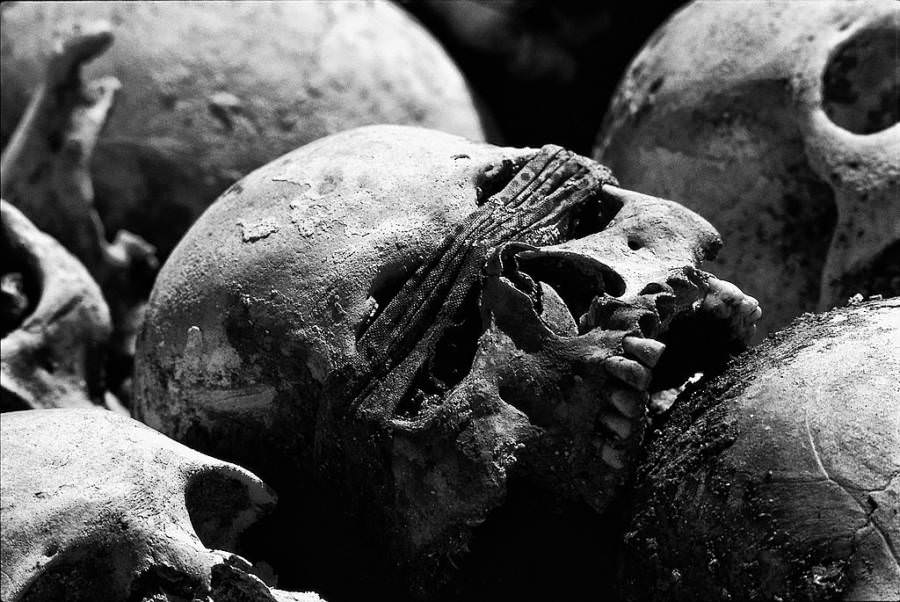
Bone-white and fractured, a cluster of human skulls fills the frame at Choeung Ek, the infamous killing fields, photographed in 1981. The close focus is unforgiving: empty eye sockets, broken teeth, and pitted surfaces are rendered with stark clarity, turning remains into a silent testimony that words struggle to match. Light and shadow carve out every contour, making the scene feel both intimate and unbearable.
Near the center, one skull lies tilted among others, a strip of fabric still stretched across it like a blindfold that time refused to remove. The surrounding crania press in from all sides, suggesting mass death rather than an isolated burial, and the tight composition denies the comfort of distance. Nothing in the image is decorative; even the grain and contrast serve the grim purpose of recording evidence.
Civil wars and political violence often get summarized as statistics, yet this photograph insists on the human cost—individual lives reduced to relics in soil and dust. For readers searching the history of Cambodia, Choeung Ek, and the legacy of the Khmer Rouge era, the image operates as both document and memorial, pointing toward the broader machinery of terror that produced such fields. It also raises a hard question about remembrance: how societies preserve proof, mourn the dead, and confront the aftermath long after the killing stops.