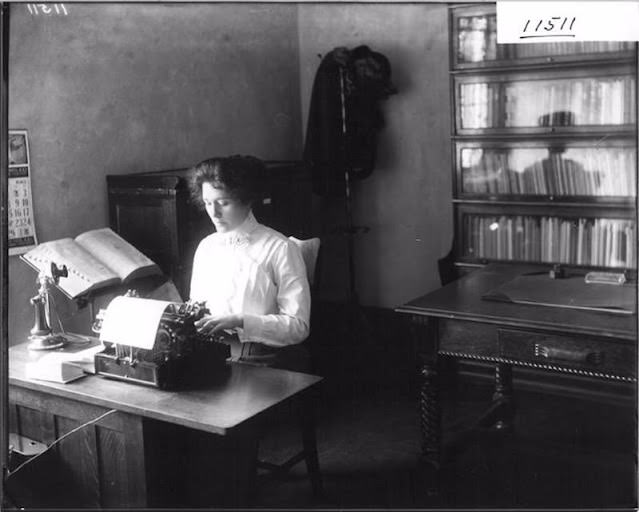
A quiet office interior frames a young woman seated at a sturdy wooden desk, her hands set on a hefty early typewriter while a sheet of paper curls forward in the platen. To one side, an open reference book rests on a stand, suggesting that her work involves careful copying, correspondence, or the drafting of records rather than casual note-taking. The subdued light, plain walls, and neatly arranged surfaces evoke the everyday rhythm of clerical life when “past inventions” like the typewriter began reshaping how information moved through businesses and institutions.
Clerical tools fill the scene with telling detail: the mechanical bulk of the machine, stacks of papers, and what appears to be a small desk device nearby, all arranged for efficiency. A coat hangs on the wall behind her, a simple reminder that this is a working environment, not a studio pose, and the cabinet of files or books in the background hints at the growing importance of organized paperwork. For anyone searching historical photos of ladies using typewriters, the image offers a clear look at how women’s office labor became intertwined with new technology and a culture of precision.
Across the early decades of modern office work, typing became both a skill and a gateway—turning the clack of keys into a sound associated with professionalism, speed, and reliability. Images like this help trace the evolution of the typewriter from novel invention to indispensable machine, and they also document the changing presence of women in administrative roles. Whether you collect vintage office photography, study the history of inventions, or enjoy glimpses of everyday working life, this photograph invites a closer look at the tools and routines that shaped the written world.