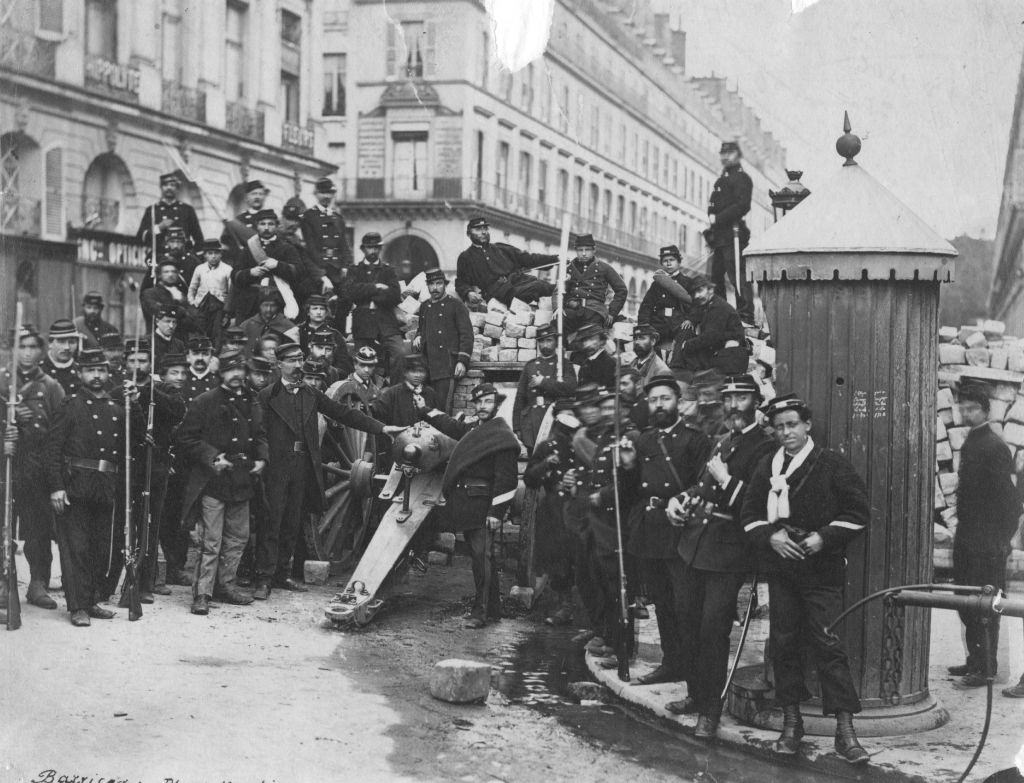
Crowded into the cobbled space of the Place Vendôme, a group of National Guardsmen pause long enough to pose beside an artillery piece and a barricade built from stacked paving stones. Uniforms, kepis, and long rifles dominate the foreground, while the elegant façades of the square rise behind them, an uneasy contrast between Parisian grandeur and improvised street defense. The camera catches not a charge or a retreat, but the quieter moment when men turn war into a tableau and occupation of the streets becomes a kind of statement.
Details reward a closer look: the cannon angled toward the viewer, the tangle of bodies perched on stone piles, and the watchful expressions that range from proud to fatigued. The barricade itself reads like urban archaeology—city streets dismantled and repurposed into fortification—suggesting how quickly civic life could be reordered after the Franco-Prussian War. Even the small shelter at the right edge and the damp, rutted roadway hint at disruption, as if the normal rhythms of the square have been suspended.
Seen within the broader story of civil conflict and political upheaval in France, the scene speaks to the National Guard’s shifting role as both militia and symbol of popular power. Place Vendôme, more often associated with wealth and ceremony, becomes a stage for armed citizens asserting presence amid uncertainty. For readers searching the visual record of the Franco-Prussian War’s aftermath, Paris barricades, and National Guardsmen in the streets, this photograph offers a stark, SEO-friendly window into a city learning to live with its own defenses.