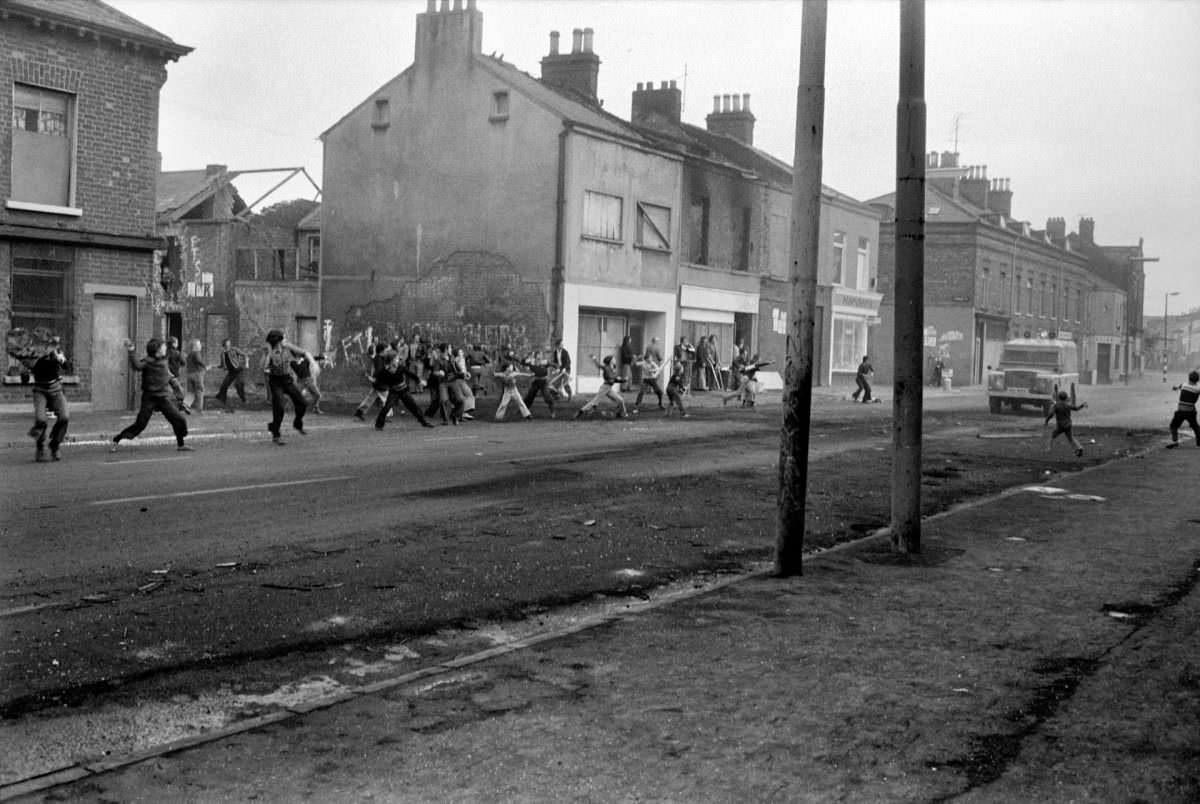
Tension spills across Leeson Street in Belfast as a crowd surges into the roadway, bodies caught mid-stride and arms raised in the unmistakable motion of throwing. The RUC vehicle sits ahead on the right, drawing projectiles and attention, while the wide, bare street amplifies the sense of exposure and risk. Terraced buildings, shuttered-looking shopfronts, and tall telegraph poles frame the scene with an everyday familiarity that makes the disorder feel even more jarring.
Along the pavement and curb, scattered debris and the uneven surface of the road hint at a neighbourhood already worn by repeated confrontations. The rioters cluster in a dense knot, some turning to follow the vehicle’s movement, others pressing forward as if pulled by momentum and anger. A few figures appear set apart from the main group, suggesting a street divided into quick decisions—advance, retreat, watch, or run.
As a piece of Troubles-era street photography, the 1978 moment captured at the top of Leeson Street speaks to the volatile relationship between community protest, public order policing, and the contested urban spaces of Belfast. It is not only an image of stoning and pursuit, but also a record of how ordinary streets became front lines during periods of civil unrest. For readers searching historical Belfast photos, RUC incidents, or the lived texture of Northern Ireland’s conflict, this photograph offers stark, unvarnished detail.