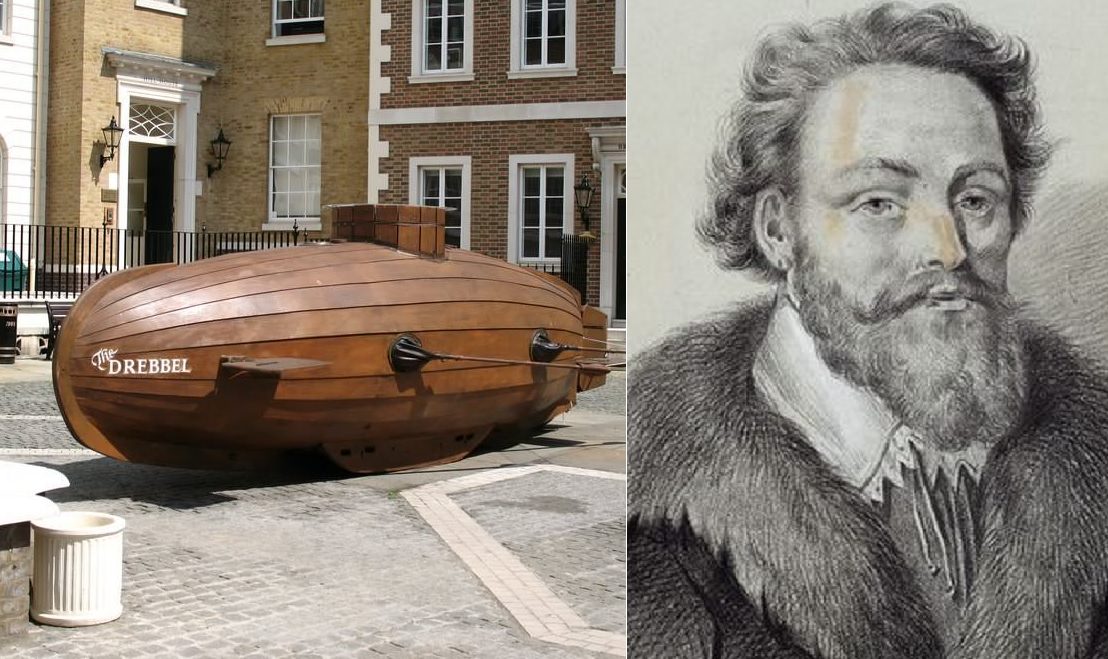
An odd, barrel-shaped vessel sits on a paved square like a visitor from another age, its ribbed wooden skin and low profile hinting at a craft designed to slip beneath the surface rather than sail upon it. The name “Drebbel” painted on the side turns the object into a talking point, while the protruding fittings at the front and the small raised section on top invite close inspection. Set against orderly brick façades and tall windows, the submarine’s compact form feels all the more uncanny—an invention that doesn’t quite belong on dry land.
Alongside it, a period-style portrait anchors the story in the early modern world, pairing engineering ambition with the face of its credited creator, Cornelius Drebbel. The title, “Submarine (1624) by Cornelius Drebbel,” evokes the long fascination with underwater navigation at a time when most technology was still bound to wind, oar, and open air. Even without technical diagrams, the juxtaposition suggests how experimentation and spectacle often went hand in hand: the inventor as both craftsman and visionary.
For readers exploring the history of inventions, this post offers a vivid gateway into the origins of submarine design and the broader quest to conquer new environments. Details like the wooden construction and enclosed silhouette speak to early solutions for pressure, propulsion, and visibility—problems that would occupy engineers for centuries. Whether approached as maritime history, Renaissance-era ingenuity, or simply a striking artifact, Drebbel’s submarine remains a memorable symbol of human curiosity pushing into the depths.