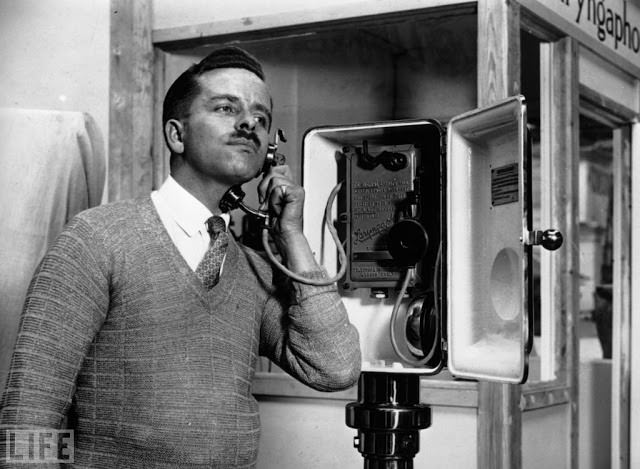
Wire and metal dominate the scene: a man in a sweater vest and tie holds a receiver to his ear while a curious cabinet-like apparatus stands open beside him. Inside, cords coil neatly around components, with a second handset and fittings arranged as if for demonstration or testing. The partially visible word “laryngaphone” in the background anchors the moment to a specific kind of communication technology, one aimed at capturing speech in an unusually direct way.
In 1929, engineers and inventors were racing to make voices carry farther, clearer, and more reliably through the growing web of modern connections. A laryngaphone—associated with throat microphones and speech pickup—evokes experiments meant to overcome background noise and improve intelligibility, whether for industrial settings, transportation, or other demanding environments. The open housing, exposed wiring, and handsets suggest a period when electronics were still tactile and legible, inviting onlookers to see how sound could be turned into signal.
For readers interested in inventions and early audio technology, this photograph offers a compelling glimpse into the practical side of innovation between the wars. It’s as much about human posture and concentration as it is about equipment: the calm, attentive expression of the operator contrasts with the boxy complexity of the device. As a historical image tagged “Laryngaphone, 1929,” it fits naturally into conversations about the evolution of microphones, telephony, and the ongoing quest to make communication work in the real world.