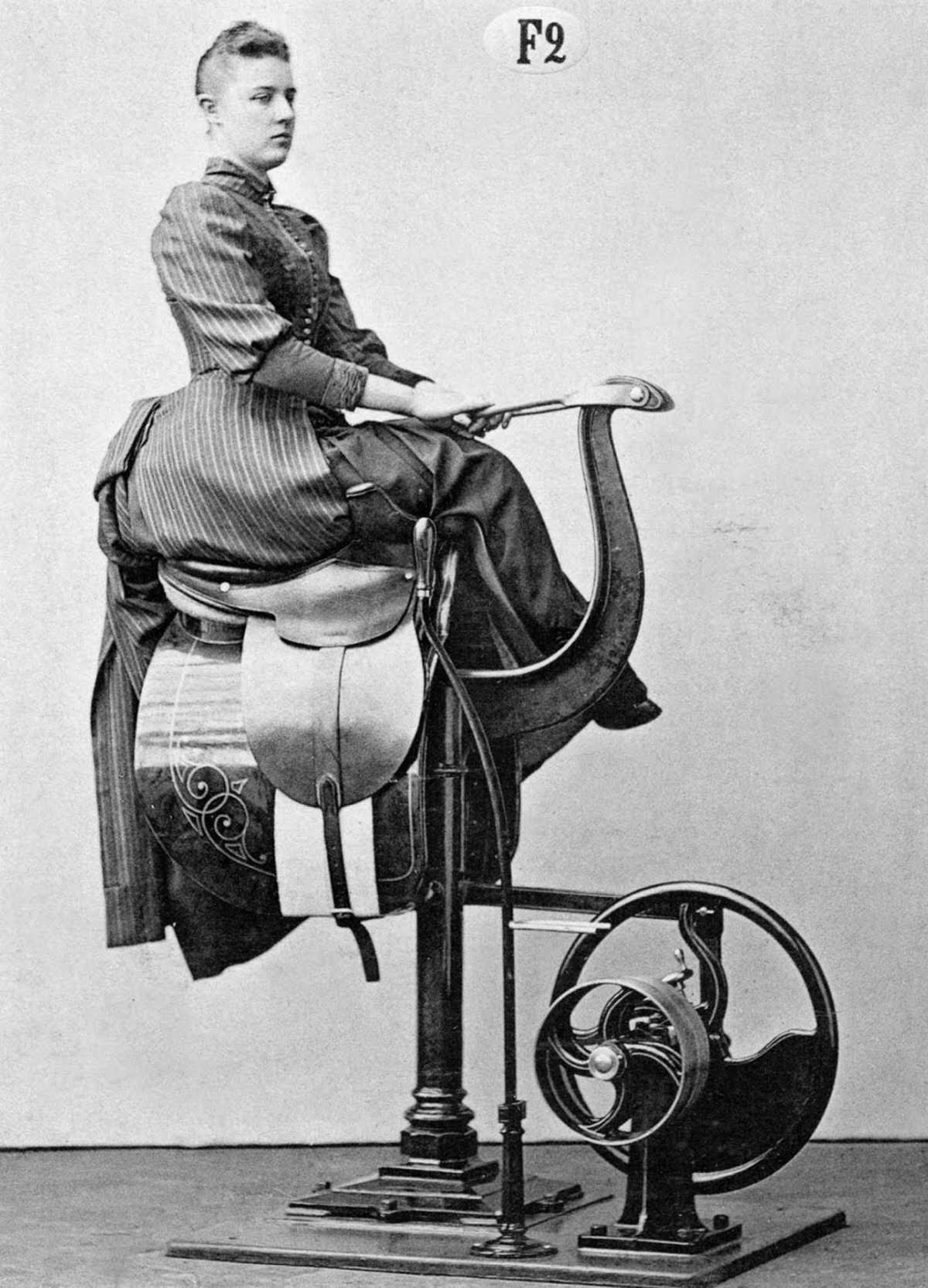
Perched side-saddle in a long, striped dress, the rider looks composed as she grips a set of reins that lead not to a living animal, but to an ingenious “horse” of metal and leather. The contraption’s arched frame and upright post mimic the posture of a mount, while the saddle and drape suggest that the experience was meant to feel familiar to anyone raised around equestrian culture. Even without a trail beneath it, the apparatus invites the viewer to imagine motion, training, and the social expectations once tied to confident horsemanship.
At the base, a prominent flywheel and mechanical linkage hint at the machine’s true purpose: to produce vibration and movement through engineering rather than muscle and hoof. In an era fascinated by inventions, devices like this promised a controlled simulation of riding—useful for those who could not, or would not, climb onto a real horse. The careful studio-style presentation emphasizes the technology as much as the rider, selling the idea that modern mechanics could deliver the “benefits” of the saddle with fewer risks.
Curiosity lingers in the details: the tension in the reins, the elevated seat, and the stark background that turns the rider and mechanism into a single, striking silhouette. Seen today, the vibrating horseback apparatus reads as part fitness machine, part therapeutic gadget, and part Victorian-era spectacle—an early step toward the exercise simulators and rehabilitation equipment that would follow. For readers interested in the history of technology, equestrian training, and unusual inventions, this photograph is a vivid reminder of how inventors tried to bottle experience itself and deliver it by machine.