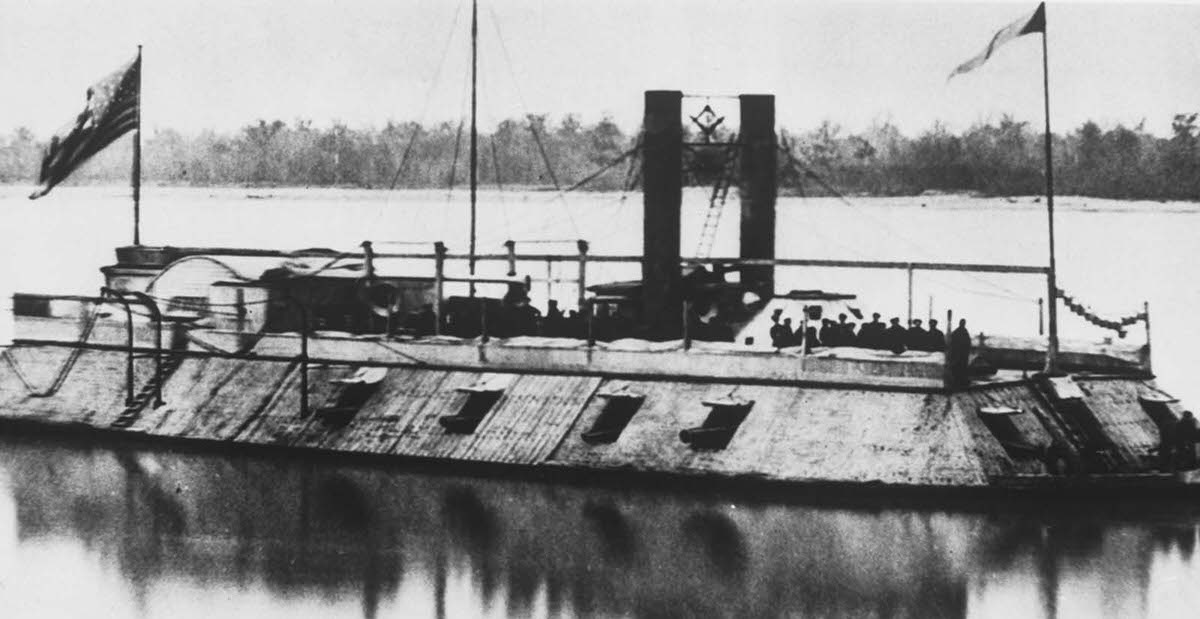
Low to the water and clad in slanted armor, the USS St. Louis appears here as a working river warship rather than a polished parade vessel. The long, angular casemate stretches across the hull, punctuated by gun ports that hint at the ironclad’s purpose: to bring heavy firepower into narrow waterways where traditional deep‑draft ships could not roam. A crew gathers along the top deck beneath simple railings and rigging, with flags lifting in the breeze over a calm, tree-lined shore.
Built in 1861 as a City-class ironclad gunboat for the Union Navy, St. Louis belonged to a new kind of Civil War technology shaped by the demands of inland combat. River ironclads were designed to fight close to fortified banks, escort transports, and contest control of strategic crossings—turning the rivers themselves into contested corridors. Details visible in the photograph, from the armored silhouette to the compact deck fittings, convey the practical engineering that defined these vessels: protection, stability, and the ability to keep moving under fire.
For readers tracing the story of Civil War naval history, images like this offer more than hardware; they reveal the scale of the craft and the human presence that operated it day after day. The composition emphasizes the ironclad’s squat strength against an open horizon, a reminder that much of the war’s outcome depended on logistics and river control as much as on battlefield lines. Viewed today, the USS St. Louis stands as an emblem of the Union’s industrial improvisation and the evolving nature of warfare on America’s waterways.