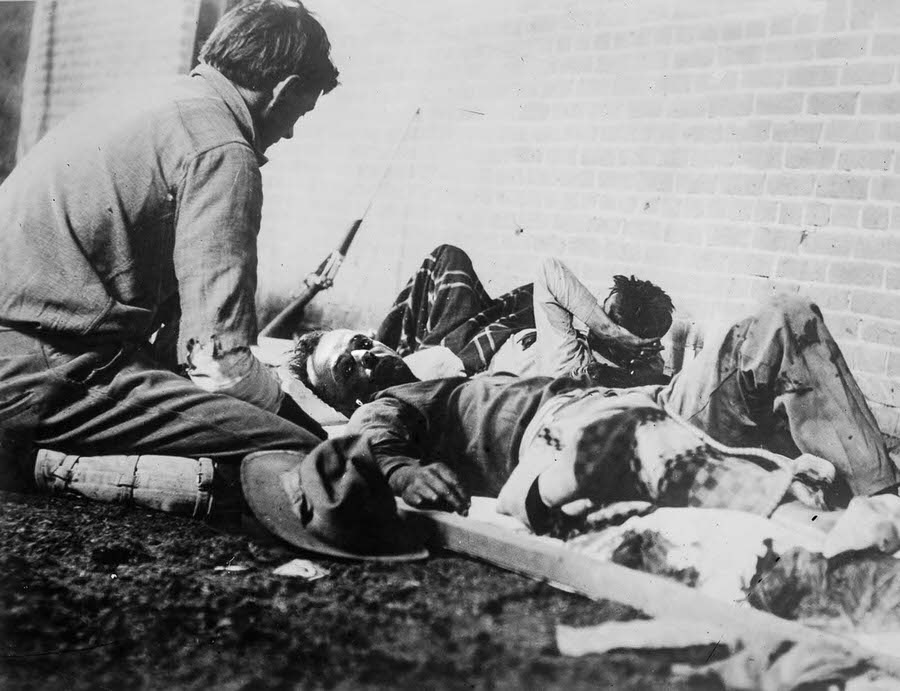
Against a plain brick wall, the aftermath of the battle for Ciudad Juarez is reduced to its most personal scale: a wounded soldier laid out on a simple stretcher while an attendant leans in to help. The scene feels improvised and urgent, with bodies resting close together on rough ground and a rifle propped nearby, as if the fighting has only just moved out of earshot. Blood-darkened fabric and scattered cloth underscore that treatment here is as much about survival and improvisation as it is about comfort.
What stands out is the intimacy of wartime medical care in a civil-war setting, where formal hospitals were often distant or overwhelmed and aid could arrive in whatever shelter could be found. The caregiver’s posture suggests triage—checking, steadying, assessing—while the injured man’s stillness communicates exhaustion more than drama. In this single frame, the “home front” disappears and the conflict becomes a cramped corner of a street or courtyard, where every minute and every bandage matters.
For readers interested in Ciudad Juarez history, battlefield medicine, and the human cost of civil wars, this photograph offers a stark counterpoint to maps and military narratives. It invites attention to the quieter labor that follows gunfire: carrying, cleaning, binding, and waiting, often with scarce supplies and little privacy. The image also reminds us that behind any account of a battle lies a parallel story of care, endurance, and the fragile line between life and loss.