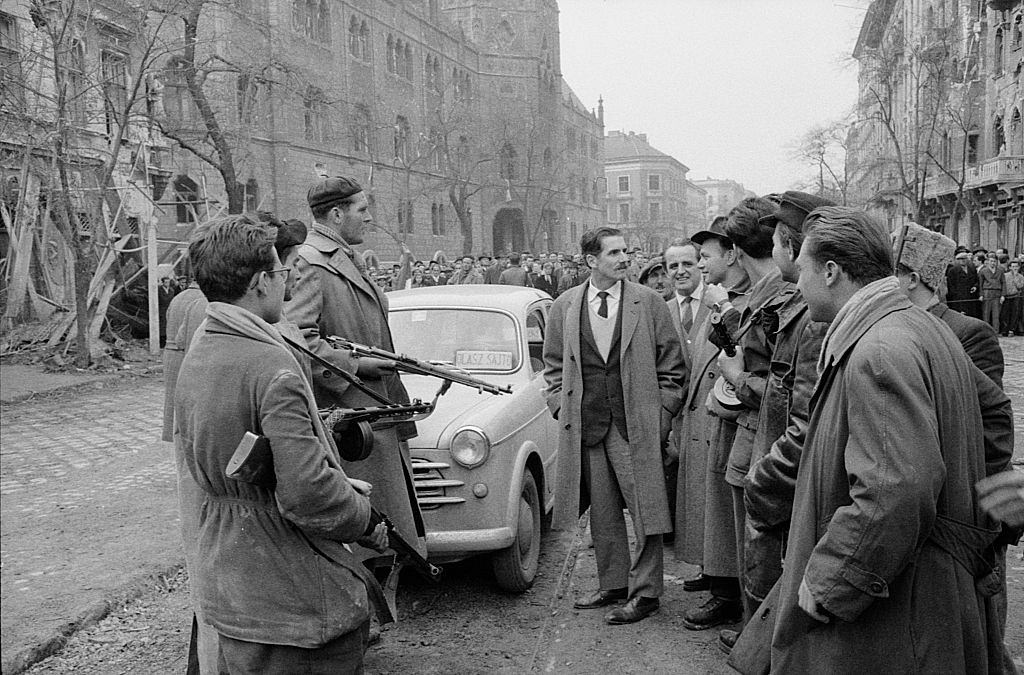
A crowded street in the capital becomes an improvised checkpoint as journalist Massimo Mauri steps into a tense reception by armed rebels. The scene is framed by stone façades and bare winter trees, with a compact car halted in the middle of the road and onlookers pressed along the edges as if drawn by the gravity of unfolding events. Coats, caps, and tightly held weapons tell their own story of uncertainty—civil war turning ordinary thoroughfares into places where authority is negotiated face to face.
At the center, Mauri’s formal suit and overcoat contrast sharply with the rebels’ practical clothing and rifles, a visual reminder of the thin line between observation and danger. He appears to be speaking or listening, surrounded by men who look ready to challenge any arrival, even one carrying a notebook rather than a command. Behind them, the gathered crowd reads like a chorus of witnesses, watching closely for signs of who controls the moment.
Tellingly, the photograph emphasizes encounter more than action: conversation, scrutiny, and the uneasy pause before decisions. For readers searching civil wars photography, rebel checkpoints, and war correspondence, this image encapsulates the precarious work of journalists entering contested capitals, where access is granted—or denied—at street level. It’s a powerful glimpse of how revolutions and internal conflicts reshape public space, turning arrival itself into a test of allegiance, nerve, and negotiation.