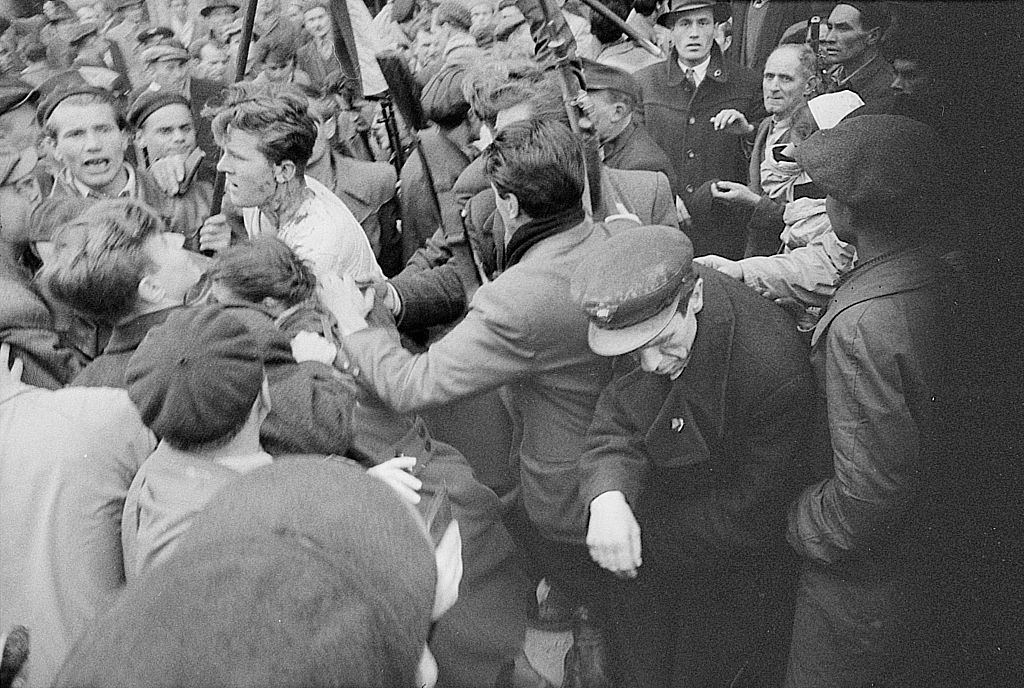
Chaos surges through the street as a dense crowd closes in, arms raised and bodies pressed shoulder to shoulder. In the middle of the crush, men in work coats and caps grapple with an injured officer of the Hungarian political police, their faces tight with anger and urgency. Rifles and sticks jut upward in the background, turning the scene into a jagged forest of improvised authority as Budapest convulses during the Hungarian Revolution of 1956.
October 30, 1956 sits at the heart of the uprising’s most combustible days, when long-suppressed grievances spilled into open confrontation and the line between justice and vengeance blurred. The officer’s cap and uniform mark him as a symbol of a feared security apparatus, while the crowd’s clenched hands and strained expressions speak to years of intimidation suddenly reversed. Nothing here feels staged: the photograph preserves a fleeting instant in a civil conflict where control changed hands in seconds.
Viewed today, the image reads as both documentation and warning, a stark reminder of how revolutions compress private lives into public reckonings. For readers interested in Cold War history, Hungary 1956, and the lived reality of civil wars, this frame offers more than a headline—it shows the physical immediacy of political collapse. It also invites a harder question: what becomes of a society when the instruments of fear are seized by the fearful, and the crowd decides the next step.