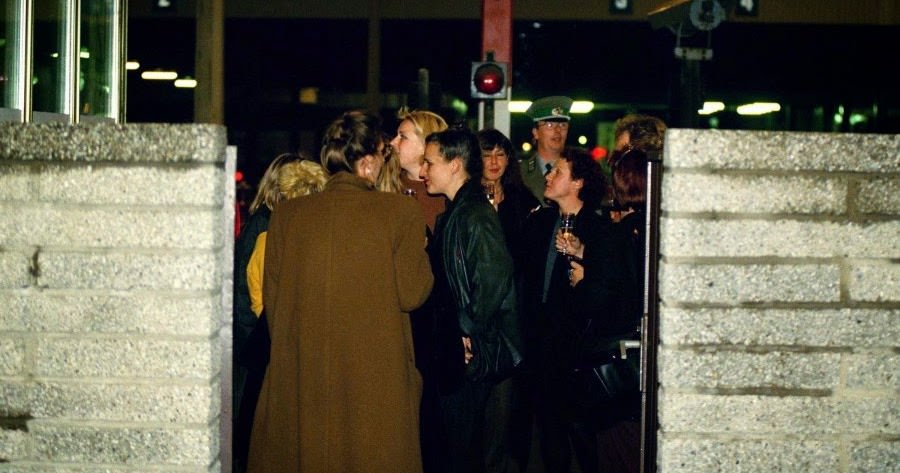
Between rough concrete barriers and the hard geometry of the border crossing, a crowd gathers in tight conversation, their faces lit by the harsh glow of nearby lights. Coats and leather jackets brush shoulders as people lean in, smiling and talking over the noise of the moment, with a raised glass catching the eye like a small toast to sudden possibility. The title places this scene at Checkpoint Charlie on Nov. 9, 1989, when West Berliners spilled into a space that had long felt sealed by rules and watchfulness.
A uniformed guard stands among civilians, a reminder that celebration and authority briefly occupied the same frame on the night the Berlin Wall began to lose its power. The setting—concrete, metal rails, and controlled entry points—still speaks the language of division, yet the body language here suggests that the border’s meaning is shifting in real time. Instead of fear or distance, there is curiosity, relief, and a shared sense that history is happening at arm’s length.
For readers searching for Berlin Wall history, Cold War Germany, and the events at Checkpoint Charlie, the photograph distills a pivotal transition into a human-scale encounter. It shows how political change can arrive not only through speeches and headlines, but through ordinary people meeting one another across a line that suddenly seems less permanent. In that narrow corridor of concrete and light, celebration becomes a quiet kind of evidence: the border crossing is still there, but the wall in people’s minds is already starting to fall.