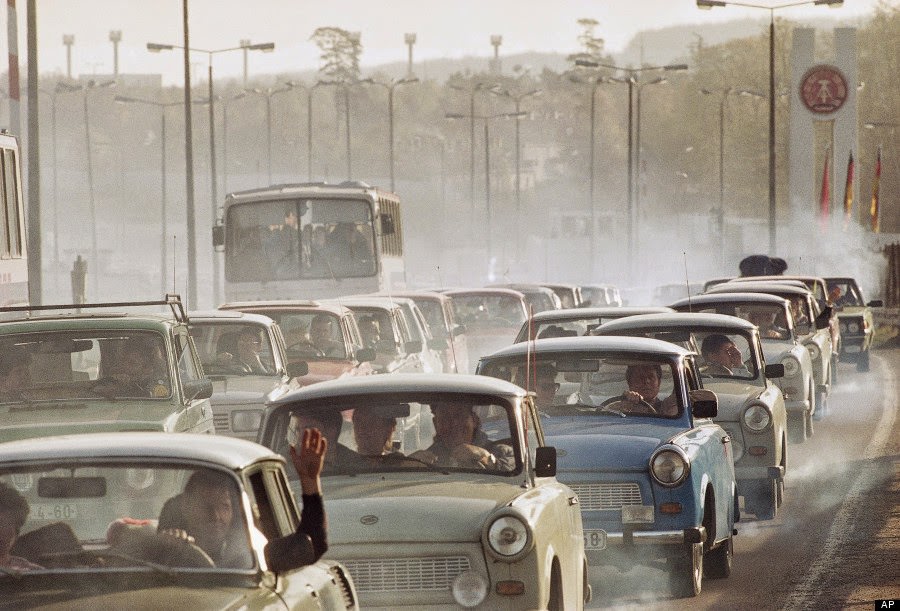
Exhaust hangs in the cold air like a low, drifting fog as a dense line of small East German cars creeps forward, bumper to bumper, toward the West German checkpoint at Helmstedt. Compact sedans with rounded headlights and simple grilles press together in a slow-moving convoy, their drivers peering ahead through hazy windscreens while the road disappears into a milky cloud. Even the taller silhouettes—buses and streetlights—seem softened by the fumes, turning a routine border crossing into something almost unreal.
Waiting becomes the central action of the scene: engines idling, doors shut against the chill, faces half-lit by late-day glare and half-lost in smoke. The two-stroke smell implied by the title feels almost audible here, a gritty reminder of everyday life in the East as it meets the sudden possibility of movement westward. In the foreground, a raised hand hints at greeting or relief, a small human gesture amid traffic, checkpoints, and state boundaries.
Taken just days after the Berlin Wall opened, the photograph distills the upheaval of November 1989 into a single roadway—history measured not in speeches but in queues. Helmstedt, long a symbol of division, becomes a bottleneck of hope where ordinary vehicles carry extraordinary expectations. For readers searching for Cold War history, East Germany, West Germany, and the lived texture of reunification’s first moments, this image offers a vivid, smoke-filled snapshot of transition.