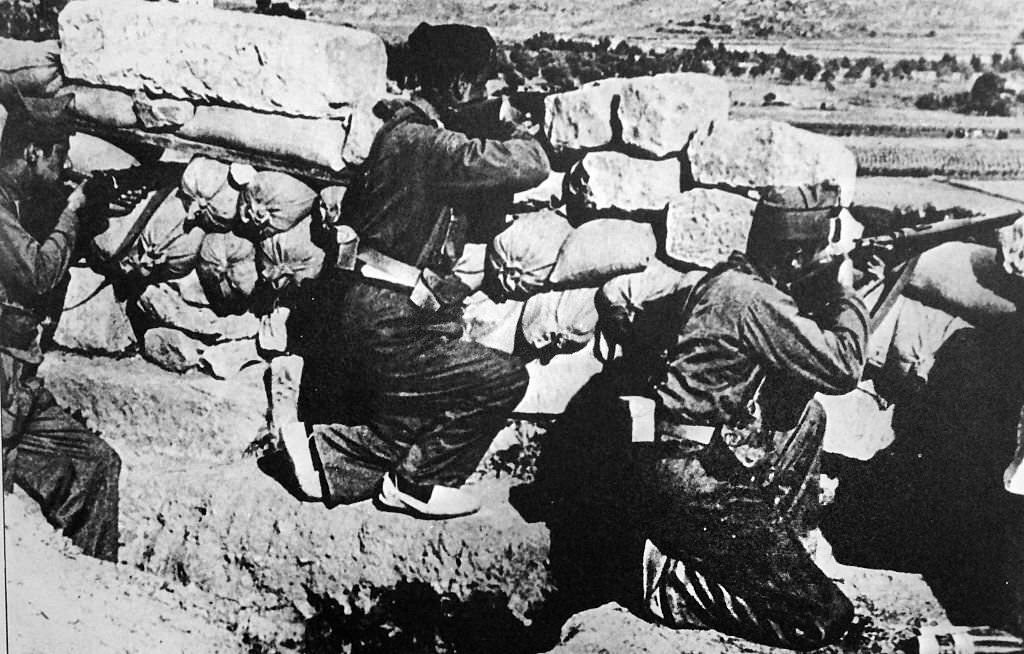
Low stone walls and hurriedly stacked sandbags form a makeshift parapet as riflemen crouch in the shallow earth, sighting across open ground toward an unseen enemy. The rough masonry, chipped and uneven, hints at how quickly the landscape was repurposed into a defensive line, while the soldiers’ low profiles and tight spacing convey the tense economy of movement that defines frontline fighting.
In the Battle of Brunete, the Spanish Civil War’s brutal logic is etched into small details: the way packs and straps cling to backs, the careful use of cover, and the stark contrast between human vulnerability and the hard geometry of field fortifications. Beyond the barricade, the distant countryside looks deceptively calm, a reminder that major battles often unfolded within sight of ordinary farmland and familiar horizons.
Scenes like this draw attention to the lived experience behind the campaign’s summaries—heat, dust, exhaustion, and the relentless need to improvise protection with whatever materials could be found. For readers exploring Civil Wars history, the photograph offers a grounded view of the Brunete fighting: not grand strategy, but bodies pressed into the ground, weapons trained outward, and a temporary wall standing between survival and catastrophe.