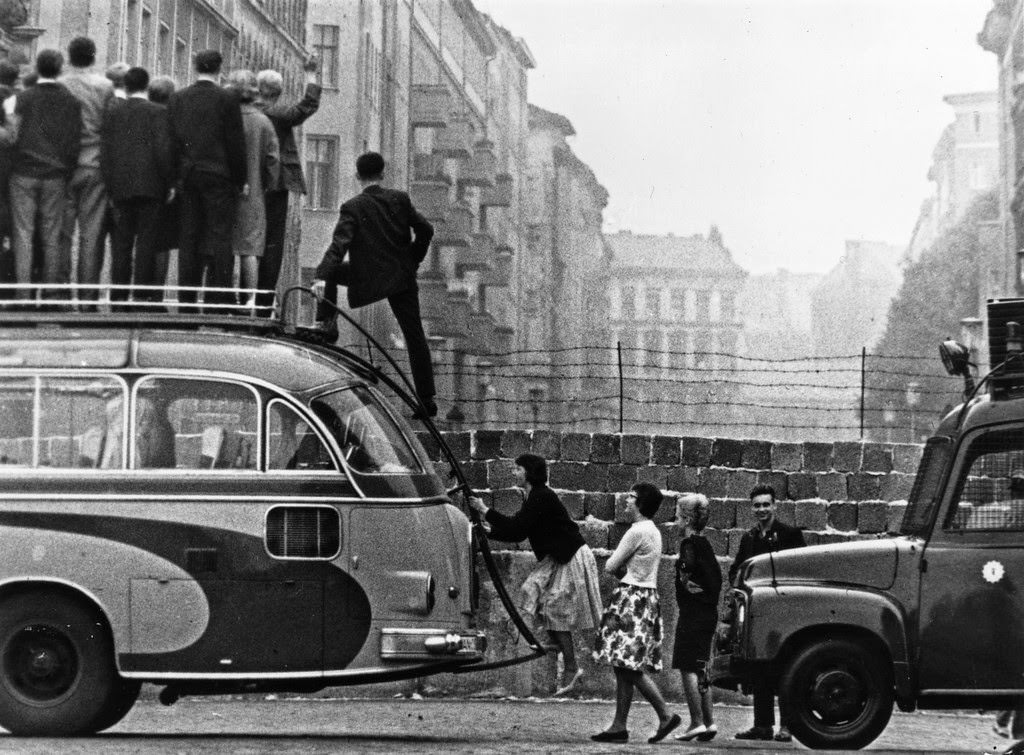
Crowds balance shoulder to shoulder on the roof of a city bus, turning an everyday vehicle into an impromptu viewing platform. Below them, a man clambers up the rear ladder while pedestrians pause in the street, their attention fixed on the barrier ahead. The scene feels hurried and strangely communal, as if curiosity has briefly overruled the normal rhythms of traffic and routine.
Across the roadway, the newly-built Berlin Wall asserts itself in rough blocks and taut strands of barbed wire, cutting through the urban landscape with stark simplicity. Apartment façades and distant rooftops frame the line of division, making clear that this is not a remote frontier but a boundary imposed amid lived-in streets. The photograph captures that early moment when a hard political decision becomes a physical structure—something people can point at, argue about, and climb up to see.
What stands out is the uneasy mix of spectacle and crisis: sightseers treating a historical rupture like a destination, while the Wall’s presence hints at fear, separation, and a city being remade in real time. For readers searching Berlin Wall history, Cold War Berlin, or rare photos of the Wall’s first days, this image offers a grounded look at how quickly borders can transform public space. It reminds us that the start of a division is not only measured in policy and speeches, but also in the ordinary bodies gathering to witness it.