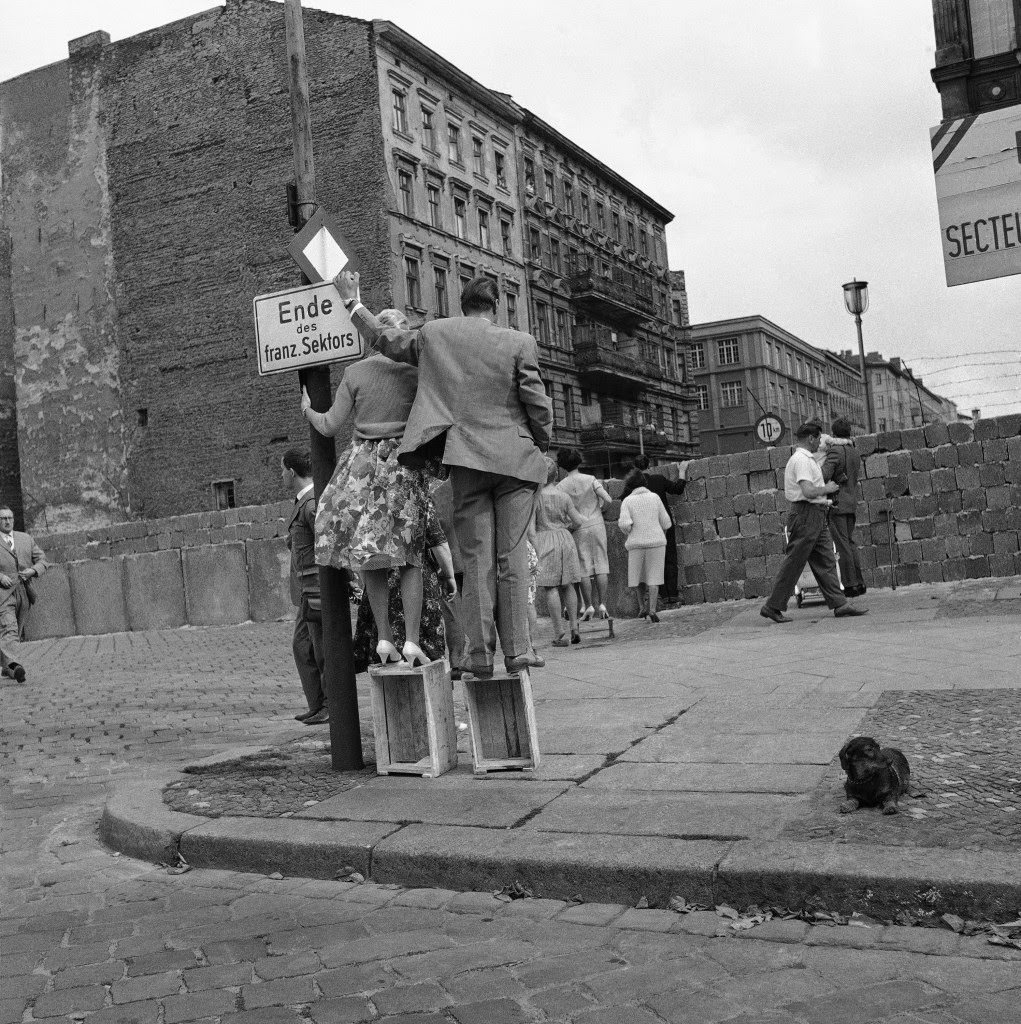
On a Berlin street corner in late August 1961, ordinary wooden crates become improvised platforms as a couple strains to see over a newly raised barrier of stacked masonry. A German street sign reading “Ende des franz. Sektors” (“End of the French sector”) anchors the moment, turning a simple act of looking into a pointed encounter with a rapidly hardening boundary.
Behind them, passersby gather in small clusters, some leaning forward, others lingering at a cautious distance, all drawn to the same obstructed line of sight. The broken textures of bomb-scarred walls and worn apartment facades frame the scene, while the rough blocks across the roadway suggest an emergency measure settling into permanence—one more seam stitched into the city’s daily routes.
The title’s detail about wooden boxes used “to overcome height of problem” reads like understatement, yet it captures the human impulse to adapt when politics reshapes the street. For readers interested in Berlin 1961, the early days of the Berlin Wall, and Cold War life at the sector borders, the photograph offers a grounded, street-level view of division: not speeches or maps, but shoes on crates, eyes above a wall, and a neighborhood learning, in real time, what separation looks like.