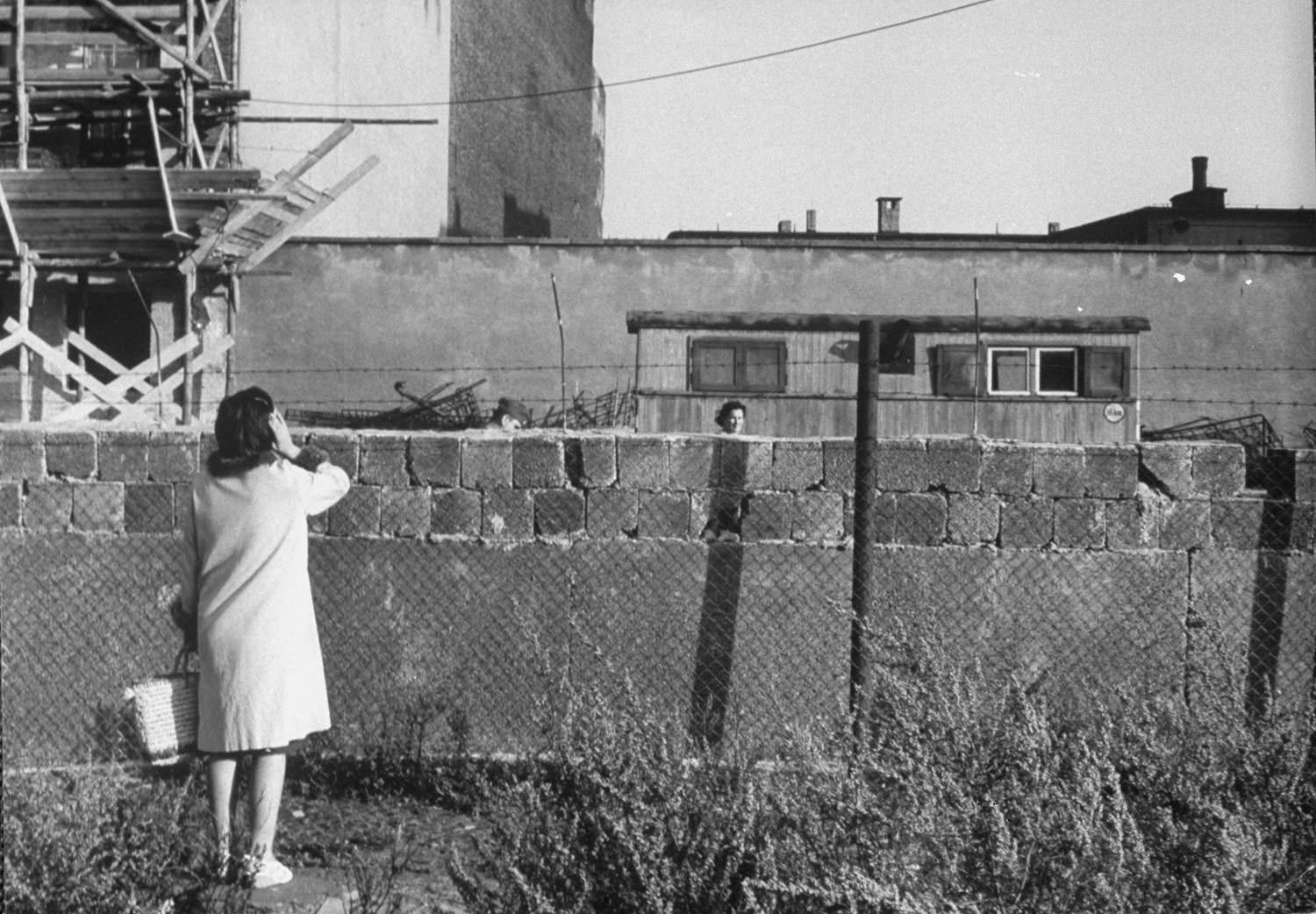
A lone woman in a light coat stands in the foreground, one hand raised to her face as if to shield her eyes or steady her voice, a woven handbag hanging at her side. In front of her, a rough barrier of stacked blocks and wire fencing cuts across the scene, turning an ordinary street edge into a hard boundary. Beyond it, another figure—her mother, according to the title—appears at a distance, separated not by miles but by a newly enforced line.
August 1961 was the moment when Berlin’s division became brutally visible, and the photograph lingers on that sudden transformation. Construction scaffolding and improvised-looking obstacles hint at a border being built in real time, while the empty spaces emphasize how quickly public life drained away from the edges. The women’s meeting is reduced to a conversation across stone and mesh, a family ritual displaced into the open air under watchful constraints.
What makes this Cold War image so compelling is its quietness: no crowds, no drama staged for the camera, just the raw everyday cost of political rupture. The distance between mother and daughter becomes the story, with the barrier acting as both physical wall and emotional wound. For readers searching the history of the Berlin Wall, East and West Berlin, and the human aftermath of 1961, this scene offers an unforgettable reminder that borders are lived first in families.