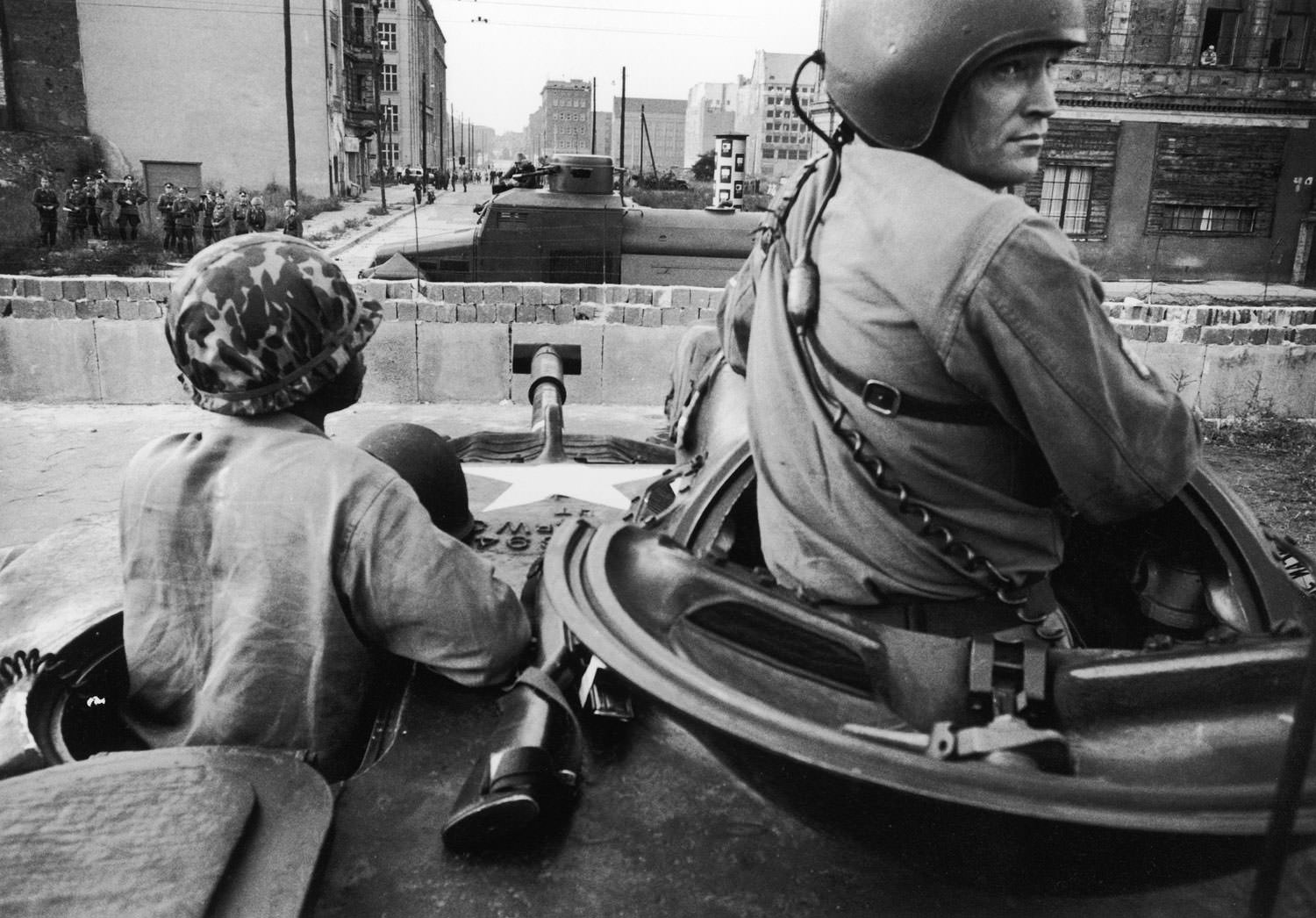
Steel helmets and tense shoulders dominate the foreground as American forces sit atop an armored vehicle, eyes fixed on the fresh barrier cutting through Berlin in 1961. The stark line of concrete blocks and rubble reads as both construction site and combat position, turning an ordinary street into a fortified edge of the Cold War. Every detail—the star marking on the vehicle, the cramped turret, the wary glance over a shoulder—suggests how quickly a city’s daily life could be recast as front-line duty.
Across the newly built Berlin Wall, East German forces gather in the distance, small in the frame yet unmistakably present, their formation echoing the standoff just meters away. Damaged façades and worn apartment buildings loom on either side, reminding viewers that Berlin still carried the scars of the previous war even as a new confrontation hardened. The emptiness between the two sides is the photograph’s loudest sound: a narrow corridor where ideology, orders, and fear met face-to-face.
For readers searching Berlin Wall 1961 photos, Cold War Berlin history, or American and East German border confrontations, this scene offers a concentrated snapshot of a divided city becoming permanent. It captures the moment when separation stopped being political language and became architecture, enforced by uniforms and armored steel. What began as “newly built” would soon define generations—proof that history can arrive not only with speeches, but with bricks stacked in the street.