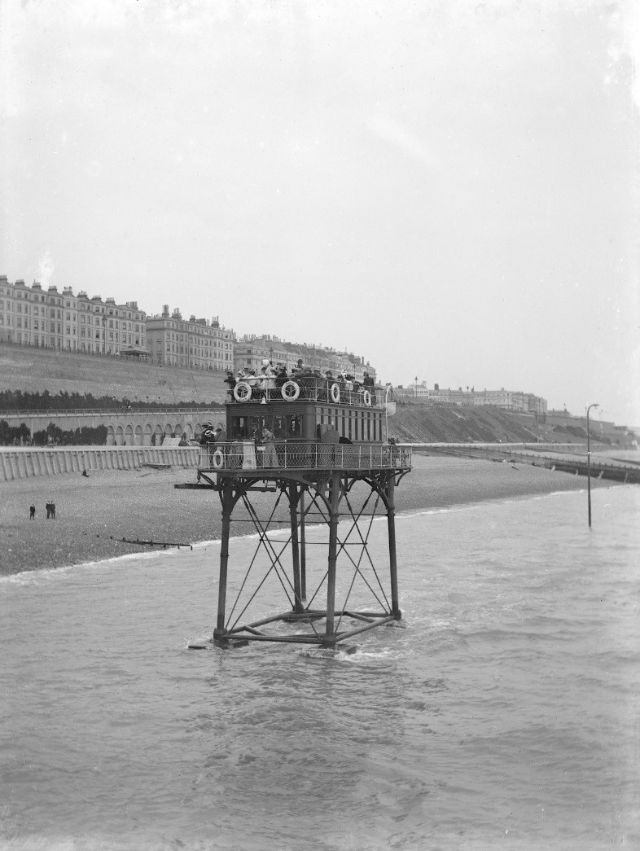
Rising out of the sea on spindly iron legs, Brighton’s “Daddy Long-Legs” looks less like a train and more like an offshore viewing platform that decided to go for a stroll. The carriage sits high above the water with passengers clustered on the roof deck, while the shoreline and long sweep of seafront buildings recede into the distance behind it. Even in a still frame, the odd balance of industry and leisure is striking: a seaside promenade on land, and an electric railway experimenting with the surf just offshore.
What made this invention so memorable was its audacity—an electric coastal railway designed to run along tracks laid on the beach while keeping the car body above the waves. The engineering reads clearly in the photograph: latticed supports, bracing, and wide-set wheels intended to cope with uneven ground and shifting tides. It’s a vivid reminder that the late Victorian era didn’t just modernize cities; it also turned holiday resorts into laboratories for unusual transport ideas.
For anyone searching the story of the Daddy Long-Legs Railway of Brighton, this historical image offers a rare sense of scale and atmosphere, from the open water to the busy seafront beyond. The scene captures the optimism of 1890s electrical invention—part practical service, part spectacle—set against a coastline that has always invited bold projects. As a piece of British transport history, it’s an irresistible example of how innovation can be both weird and wonderful.