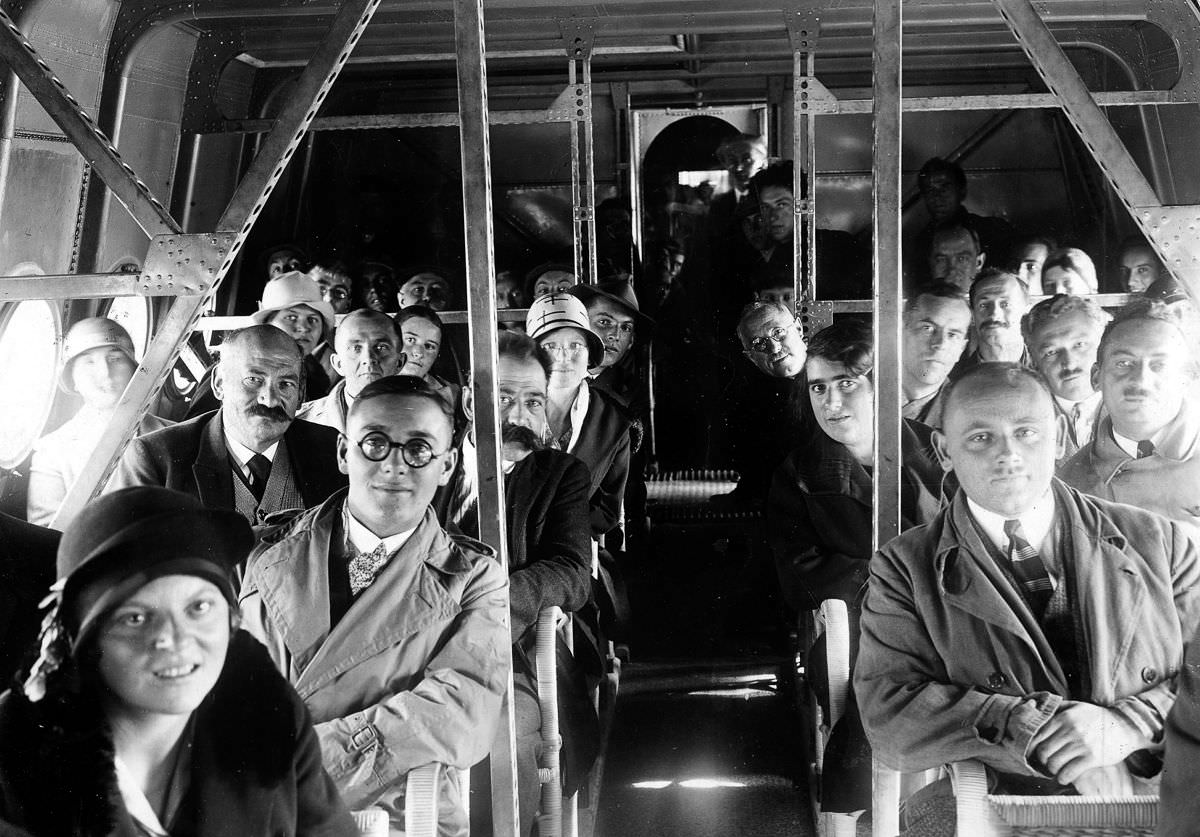
Inside the cavernous cabin of the Dornier Do-X, employees and crew staff sit shoulder to shoulder, their faces turned toward the camera with a mix of pride, curiosity, and plain airborne endurance. Metal ribs and struts frame the scene like the skeleton of a ship, reminding viewers that early long-range flight borrowed as much from boatbuilding as it did from aviation. Woven-backed seats and the narrow central aisle suggest a working environment—practical, noisy, and unforgettable—rather than the polished comfort later associated with passenger travel.
Taken on a flight over Lake Constance, Germany, on Oct. 21, 1929, the photograph feels like a group portrait of a company testing its own bold promise. The Do-X was a symbol of interwar ambition: a flying boat built to prove that immense aircraft could lift reliably from water and carry people as a matter of routine. Expressions in the crowd tell their own story—some confident, some cautious—as if everyone on board understood they were participating in a public experiment of modern engineering.
For readers interested in aviation history, German innovation, and the early era of large flying boats, this image offers rare, human-scale evidence of what “progress” looked like in practice. It’s not just machinery and specifications, but the community around them—technicians, staff, and crew sharing a single compartment while the lake slid beneath the hull. Seen today, the Do-X cabin becomes a time capsule of 1920s aeronautics, capturing the moment when daring design met the lived reality of flight.