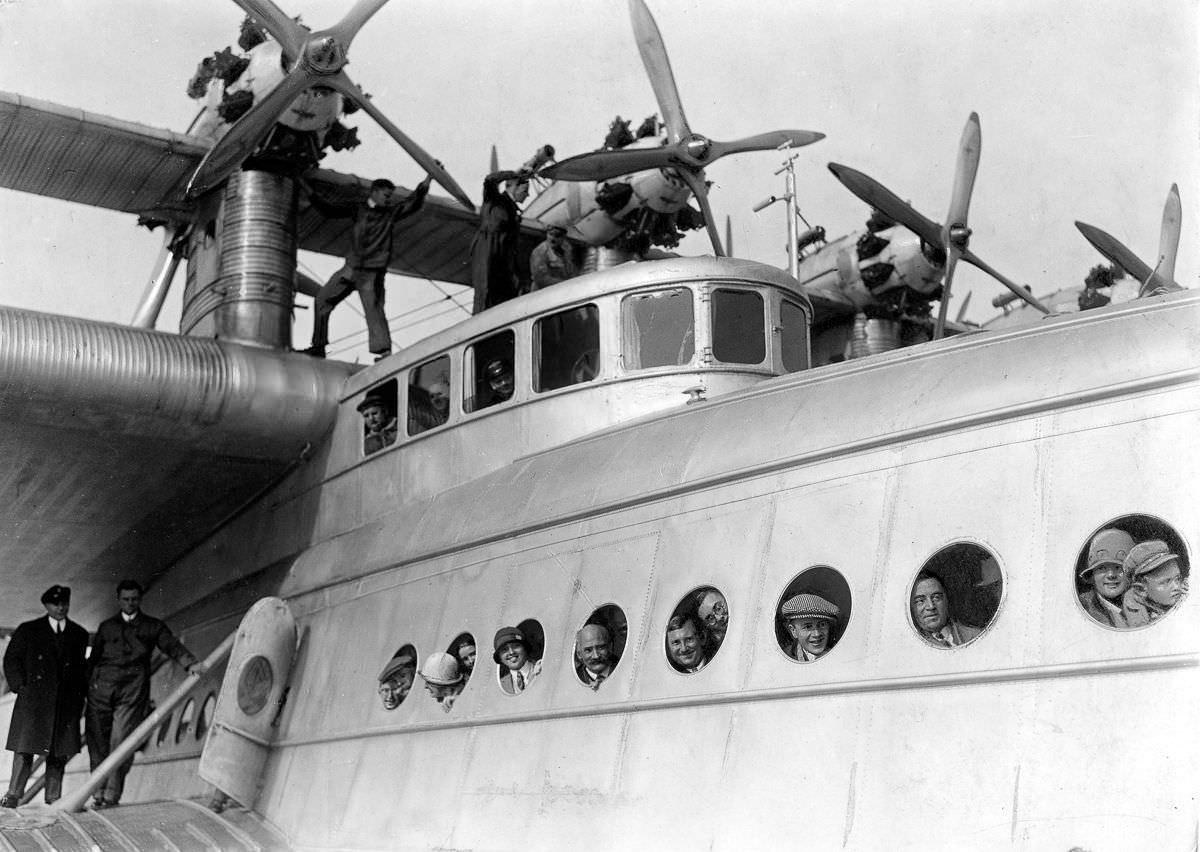
Oct. 21, 1929, lands on a moment when aviation still felt like a bold new invention—part engineering experiment, part public spectacle. The photograph centers on a massive multi‑engine aircraft with a streamlined hull and a row of round porthole windows, hinting at the era’s fascination with taking travel from the sea into the sky. Above the cabin, several propellers line up in a repeating rhythm, their blades poised like spokes, underscoring how much of early flight depended on visible, mechanical power.
Along the windows, faces appear one by one—passengers peering out with a mix of curiosity and quiet confidence—turning the aircraft into a stage for modernity. On top, crew members stand near the engines, dwarfed by the scale of the machine and its exposed working parts, a reminder that “inventions” were maintained by hands as much as by ideas. The polished metal skin catches the light, and the tight framing lets you feel the crowding, noise, and anticipation that likely surrounded an event like this.
Placed against its title, this image reads as a snapshot of technological optimism on the eve of enormous change, when progress was measured in bigger airframes and more propellers. It’s a strong visual for anyone researching early commercial flight, interwar transportation, or the history of engineering design—especially the transitional period when aircraft borrowed the vocabulary of ships. For a WordPress post, it invites readers to look closely at details—windows, engines, crew positions—and imagine how daring this kind of air travel must have felt in 1929.