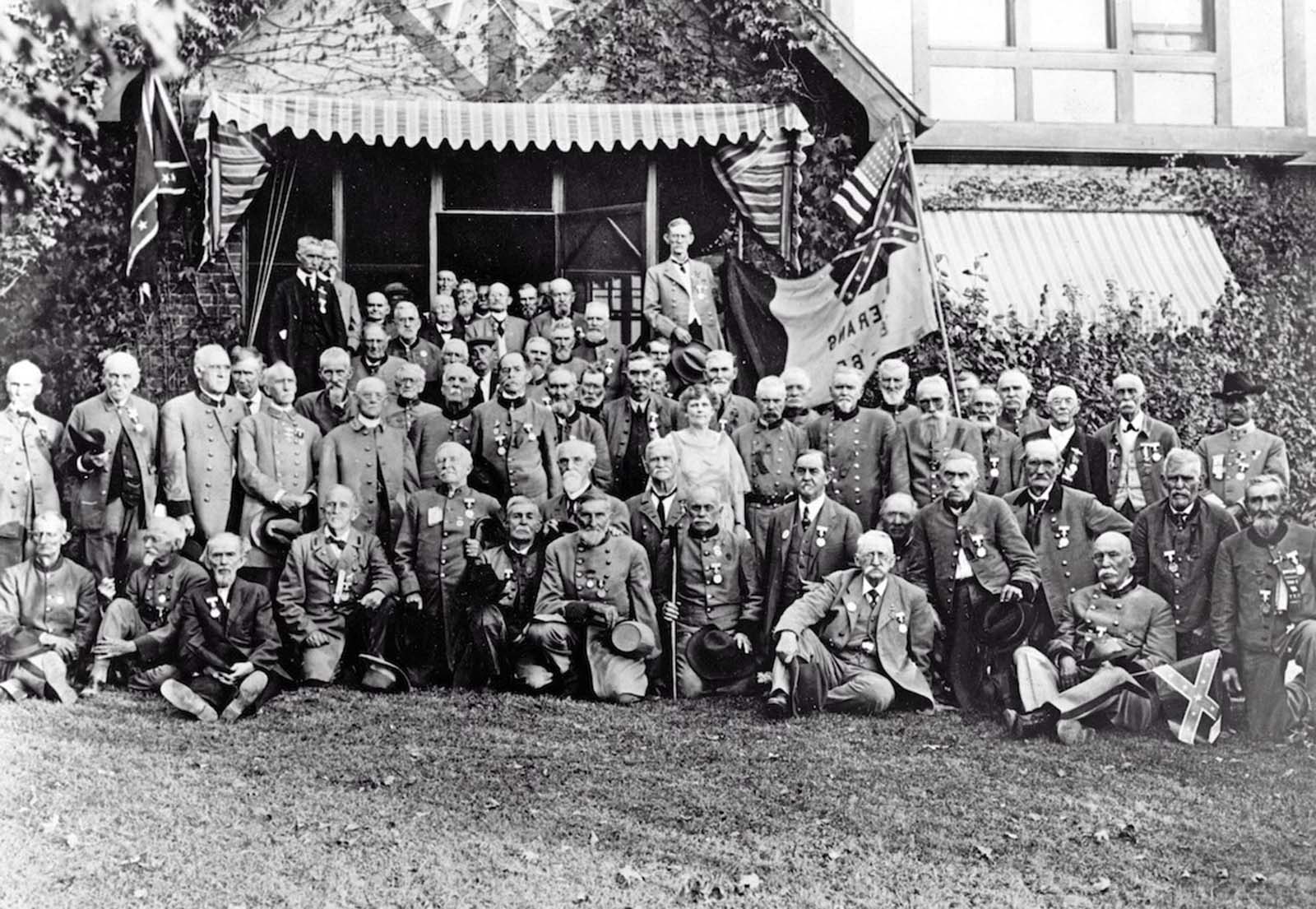
Beneath striped awnings and a tangle of summer greenery, a large circle of aging men assembles for a Confederate cavalry veterans’ reunion in Chattanooga, Tennessee, in 1921. Their faces—lined, mustached, and watchful—tell of years that stretch far beyond the Civil War, while the careful arrangement of standing and seated rows suggests the importance of the occasion. A few figures anchor the scene from the porch, posed with the formal stillness of early 20th-century group portraits.
Uniform coats and lapel badges stand out across the crowd, joined by the ever-present hats held in hands or resting on knees. Confederate battle flags and an American flag frame the gathering, signaling how memory, identity, and patriotism were publicly staged at such reunions. The photograph’s setting—part home, part meeting place—adds a domestic intimacy to a ritual that was also deeply political in the way it presented the past.
Reunion images like this are more than keepsakes; they are artifacts of how the postwar South narrated itself decades after Appomattox. In the early 1920s, surviving veterans were elderly, and these meetups often served as both commemoration and last roll call, capturing comradeship alongside the era’s dominant public interpretations of the Civil War. For readers searching Civil War history, Chattanooga heritage, or Confederate veteran reunions, this portrait offers a stark, human-scale view of how the conflict was remembered—long after the fighting ended.