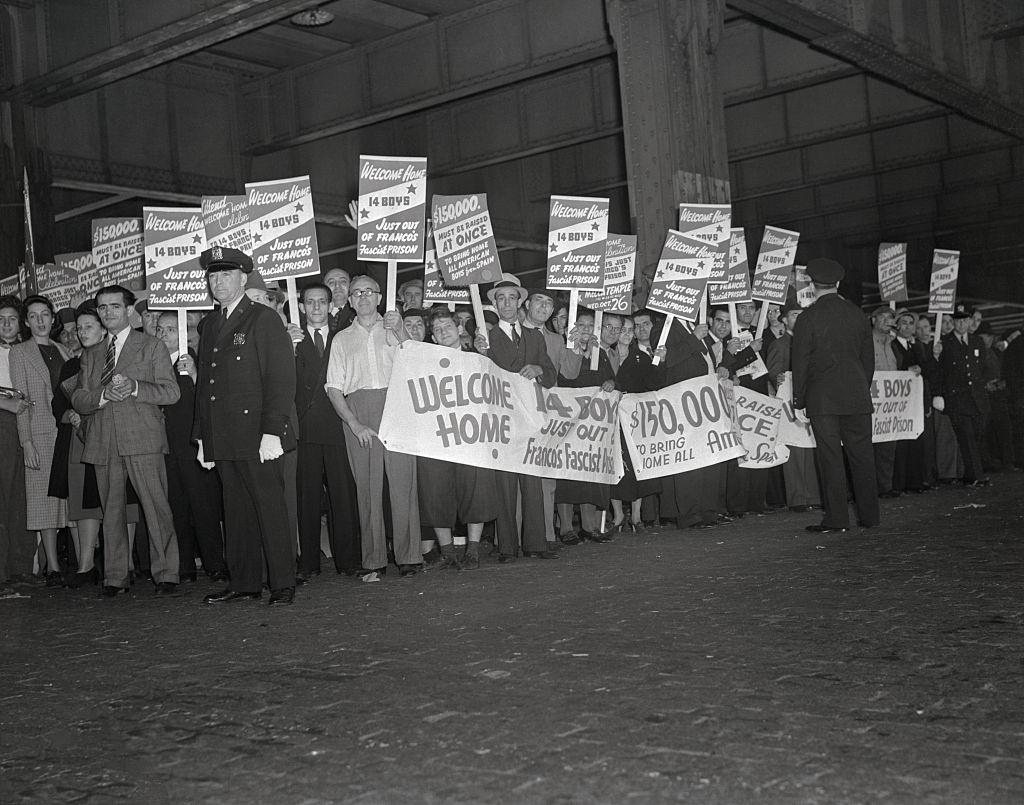
Under a cavernous terminal roof, a tightly packed crowd waits behind a line of banners and placards, their faces turned toward an unseen arrival. Uniformed officers and civilians stand shoulder to shoulder, while hand-painted signs rise above the heads like a forest of demands and greetings. The largest banner, stretched across the front, reads “WELCOME HOME,” giving the scene the charged atmosphere of a public homecoming rather than a quiet reunion.
Many of the posters focus on “14 boys” and the “Franco’s fascist prison,” language that points directly to the Spanish Civil War and the international controversy it stirred in the United States. Other slogans press for funds and action, mixing protest with solidarity in a way that feels urgent and organized. The message is not simply celebratory; it is political, shaped by anti-fascist sentiment and the pressure of advocates trying to bring imprisoned volunteers back from Spain.
Titled “Veterans with Posters and Banners Awaiting American Troops from Spain, 1938,” this historical photo preserves a moment when street-level activism intersected with wartime experience. The tightly framed crowd, the bold lettering, and the insistence of repeated phrases evoke the era’s grassroots networks, from veterans’ circles to labor and community organizers. For readers exploring 1938 history, American responses to the Spanish Civil War, and home-front protest culture, the image offers a vivid window into how public opinion was carried—quite literally—on signs.