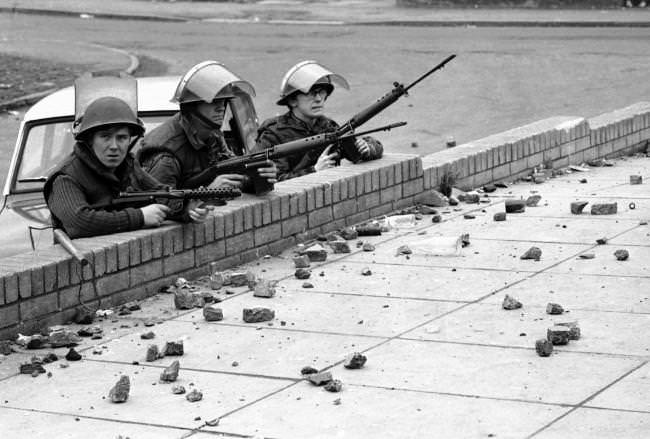
Behind a low brick wall in Andersonstown, three British soldiers keep their heads down and their eyes forward, using the curb-height barrier as the only solid cover on an exposed street. Two cradle long automatic rifles while the man on the left grips a Stirling sub-machinegun, the weapons angled just above the bricks as if expecting movement at any moment. A parked car sits awkwardly close behind them, turning a commonplace bit of Belfast streetscape into an improvised fighting position.
Scattered across the pavement in the foreground, broken masonry and thrown stones tell the other half of the story without showing the crowd itself. The helmeted figures, tense faces partly shadowed by their visors, embody the uneasy mix of military posture and urban vulnerability that defined many confrontations during the Troubles. Even the neat grid of sidewalk slabs feels disrupted, a reminder of how quickly ordinary neighborhoods could become battlegrounds.
Dated Nov. 1, 1971, the scene is tied to riots that followed the shooting of two policemen, a stark marker of escalation and grief feeding into further violence. For readers searching Civil Wars, Northern Ireland riots, Andersonstown Belfast 1971, or British Army street clashes, the photograph offers a direct window into the lived reality behind those terms. It’s an unvarnished moment of shelter, force, and fear—captured at ground level where political conflict became immediate and personal.