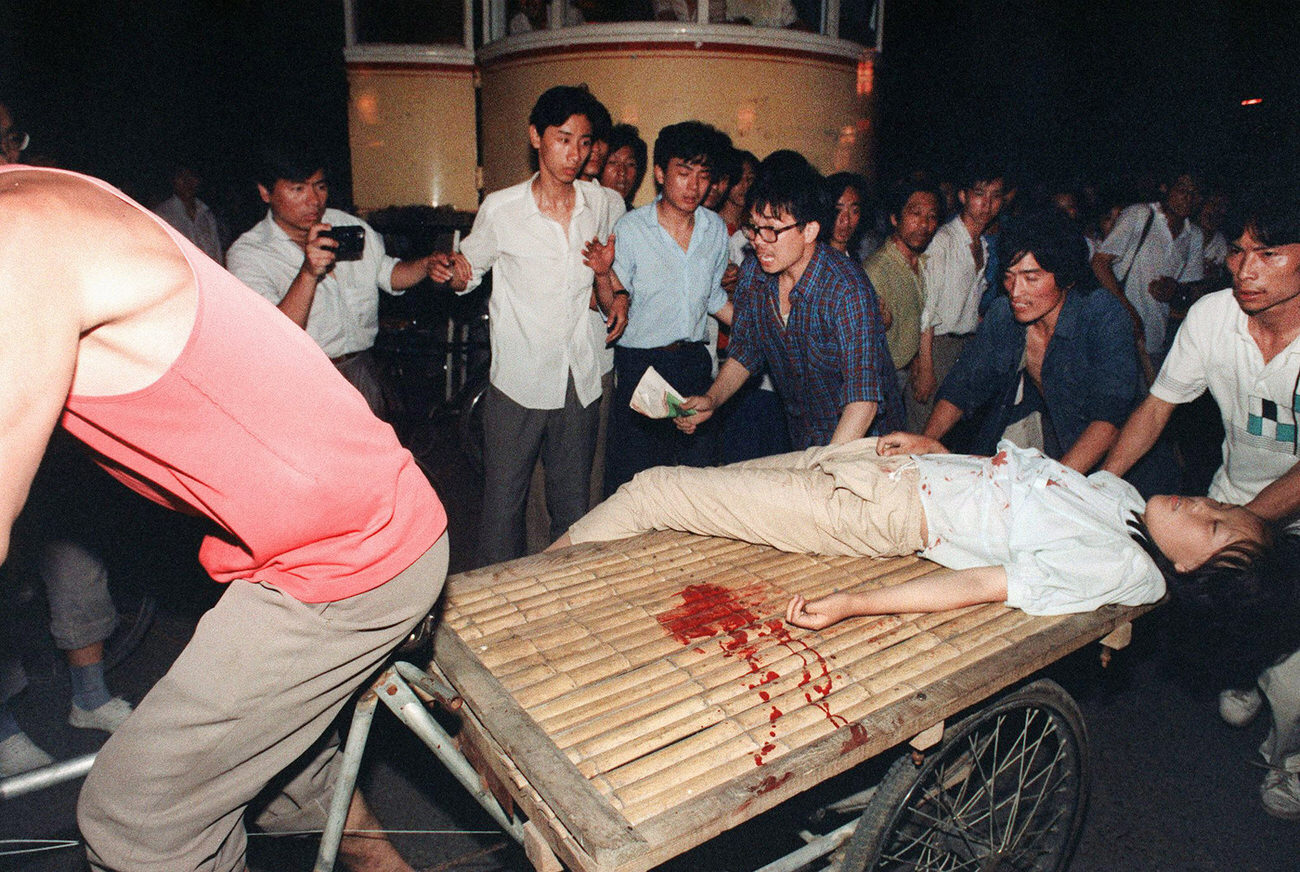
Under harsh nighttime lighting, a small crowd presses in around a hand-pulled cart as a wounded girl lies stretched across a bamboo platform, her clothing and the slats beneath marked by fresh blood. Faces blur with motion and alarm—one man leans forward as if to clear a path, another clutches money or paper, while others look on with the stunned focus that follows sudden violence. The scene feels improvised and urgent, a street turned into a corridor of evacuation.
The title points to a clash between the army and students, and the photograph’s power rests in how quickly political conflict collapses into personal crisis. There are no uniforms in the frame, no banners to explain allegiance—only civilians acting as stretcher-bearers, using whatever transport is at hand to get the injured away. In moments like this, the machinery of civil unrest is measured not by speeches or slogans, but by the scramble to preserve a single life.
For readers interested in civil wars, student movements, and the human cost of state confrontation, this image offers a stark, documentary immediacy that complements broader historical narratives. It invites questions about what happened just outside the camera’s view, how communities organize amid chaos, and why young people so often find themselves on the front lines of upheaval. Seen today, it remains a sobering reminder that the most enduring evidence of conflict is often carried not in archives, but in bodies, streets, and the hurried tracks of a cart.