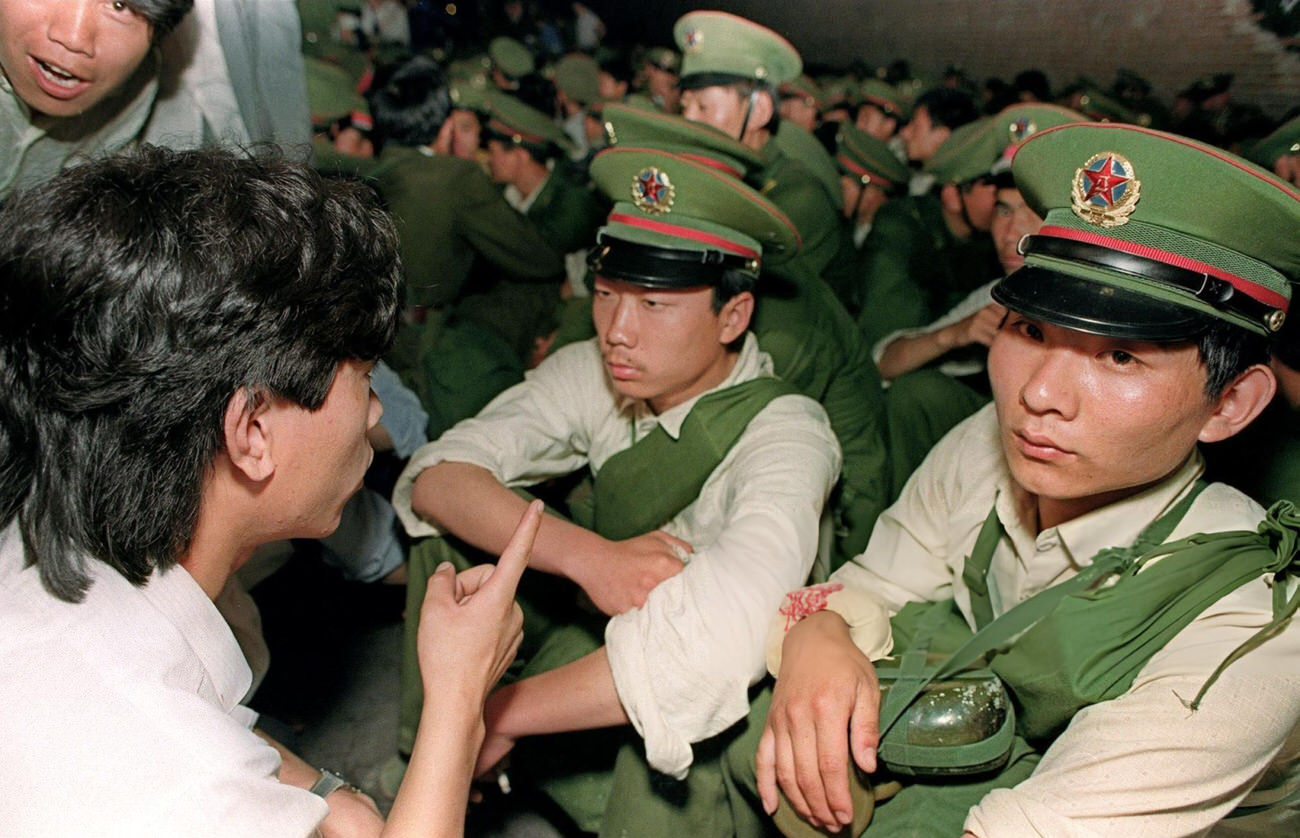
Across a tight corridor of bodies and uniforms, a young dissident student leans forward to speak to soldiers, his raised finger turning a conversation into a plea. The men in green sit shoulder to shoulder, caps pulled low, faces set in the wary stillness of a long night. In the press of the crowd behind them, authority feels both overwhelming and strangely fragile—close enough to touch, yet uncertain in what comes next.
The title’s demand—“go back home”—cuts to the heart of many civil wars and internal crackdowns, where the boundary between protection and occupation blurs in the streets. Here, the soldiers’ posture suggests exhaustion more than triumph, while the student’s insistence carries the moral weight of civilian resistance. It’s a moment of confrontation without visible violence, where words and presence become the only weapons available.
Seen today, this 1989 scene reads as a compact lesson in power, protest, and the human cost of deploying armed force against one’s own people. The photograph’s close-up perspective pulls the viewer into the negotiation itself: a citizen trying to reclaim public space, and soldiers caught between orders and conscience. For readers searching for historical context on dissent, student movements, and civil conflict, it offers a stark, intimate record of how history often turns on encounters measured in inches.