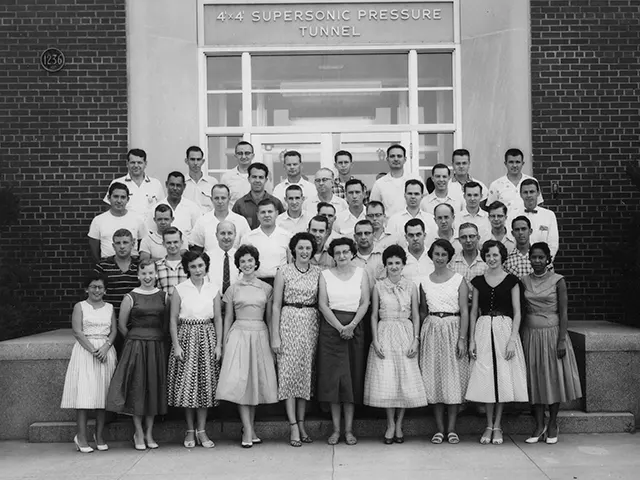
Beneath the bold lettering of the “4×4 Supersonic Pressure Tunnel,” a large NACA team gathers on the steps in crisp shirts, ties, lab coats, and mid-century dresses, posed with the quiet confidence of people who spend their days turning airflow into numbers. The building façade and neatly arranged rows suggest an organized, high-pressure workplace—one where precision mattered as much as the machinery behind the doors. It’s a formal group portrait, yet the mix of expressions hints at the everyday camaraderie that keeps a demanding research program moving.
The title points to the often-overlooked backbone of aeronautical progress: the human computers and support staff who processed data long before digital computing became routine. In a facility dedicated to supersonic testing, measurements from instruments had to be reduced, checked, graphed, and compared—work that required mathematical skill, patience, and an eye for error. The composition of the group underscores how many hands were involved in producing reliable wind-tunnel results for aircraft design and high-speed research.
For readers searching the history of NACA, wind tunnels, and 1950s aeronautics, this photograph offers a grounded reminder that breakthroughs were made by teams, not just by machines. The Supersonic Pressure Tunnel sign anchors the scene in a specific research environment, while the people in front of it represent the day-to-day labor of American aviation innovation. Seen today, the image serves as a visual bridge between the era of slide rules and the coming age of spaceflight, when data—and the people who mastered it—were everything.