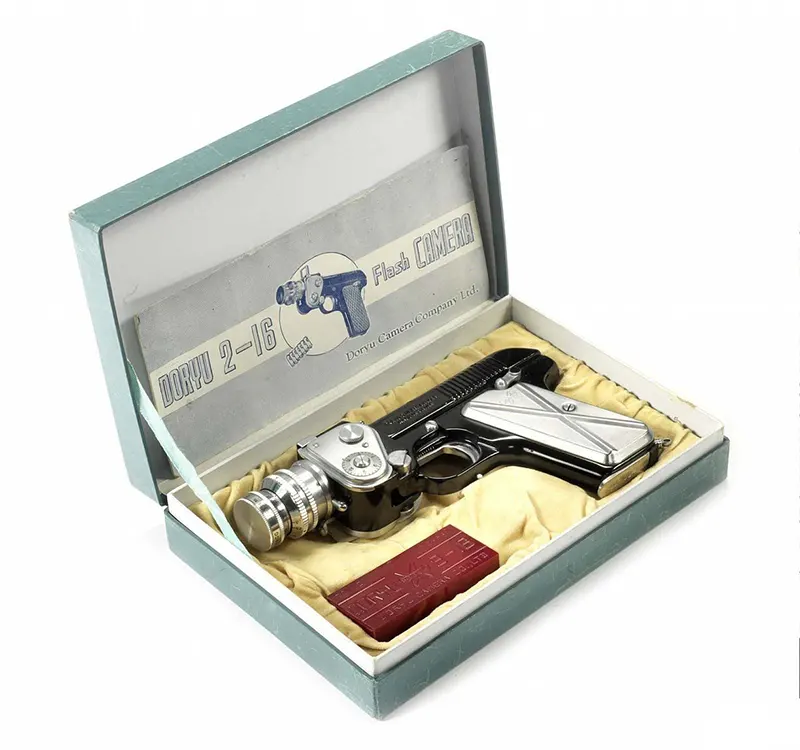
Opened like a jeweler’s case, the “Dory 2-16 Flash Camera” rests in padded satin, its silhouette borrowing the unmistakable lines of a handgun while housing a lens at the muzzle. The printed insert in the lid reinforces the dual identity—part camera, part weapon-shaped device—highlighting the mid-century fascination with compact engineering and dramatic industrial design. Even the metal finish and angular panels feel purposeful, suggesting an object built as much for immediacy and concealment as for photography.
Developed in 1954 and shot on 16mm film, this gun camera represents a niche branch of photographic invention where documentation and policing overlapped. The title notes that it was one of two gun cameras used by Japanese police, hinting at controlled, specialized deployment rather than consumer novelty. In an era before digital evidence and body-worn cameras, a concealed film camera could capture events quickly, turning fleeting moments into physical frames that could be developed and examined.
Details in the presentation box—brand labeling, the fitted lining, and the compact accessories tucked beside the camera—speak to a product meant to be carried, handled, and relied upon in the field. For collectors and historians of surveillance technology, early law-enforcement photography, and unusual camera designs, this artifact bridges two histories: the evolution of 16mm film devices and the changing tools of public safety. It also invites a broader reflection on how technology can alter behavior, when the act of “aiming” might simultaneously be the act of recording.