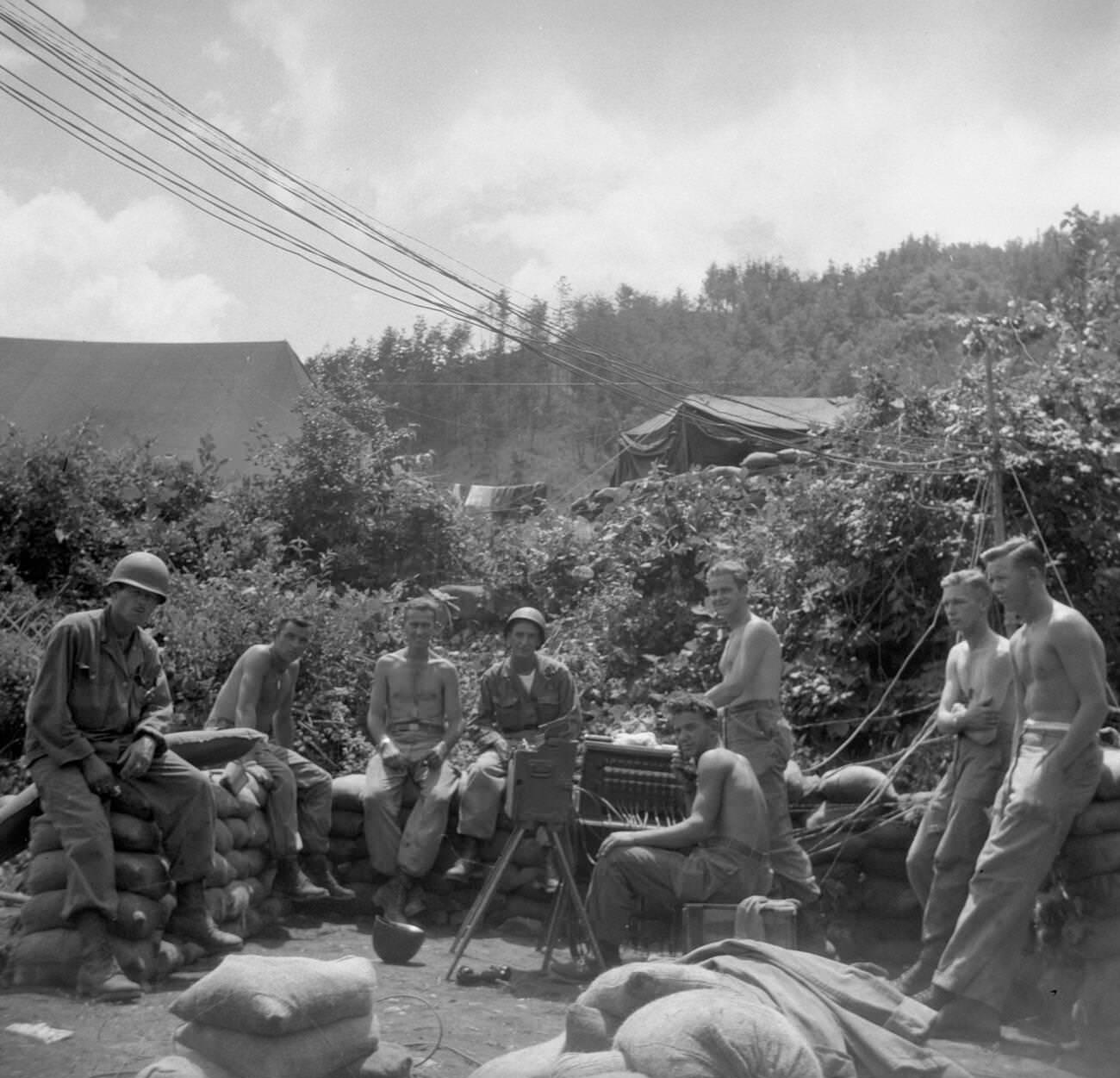
Under a web of field telephone lines, a small group of Second Infantry Division soldiers takes a rare breather during the Korean War. Sandbags form a low perimeter, while thick summer foliage and canvas tents hint at a temporary position carved out of the landscape. Several men lounge with sleeves rolled up or shirts off, their postures loose, as if savoring a pause between duties that rarely stayed quiet for long.
The centerpiece is the signal gear: a compact switchboard or communications set perched on a tripod, cables spilling outward like veins that keep the unit connected. In wartime, signalmen were the nervous system of a division—routing messages, maintaining lines, and repairing breaks under pressure—so even “relaxing” often happened within arm’s reach of the equipment. The photograph quietly emphasizes how modern combat depended as much on wires, coordination, and routine maintenance as on rifles and front-line movement.
What makes the scene memorable is its ordinary humanity, set against the larger story of the 1950s Korean War. Faces turn toward the camera with a mix of curiosity and fatigue, while the improvised fortifications and scattered gear ground the moment in daily field life. For readers searching for Korean War history, Second Infantry Division images, or signal corps communications in combat zones, this candid glimpse offers a textured reminder that military history is built from countless short intervals like this—caught between work, waiting, and endurance.