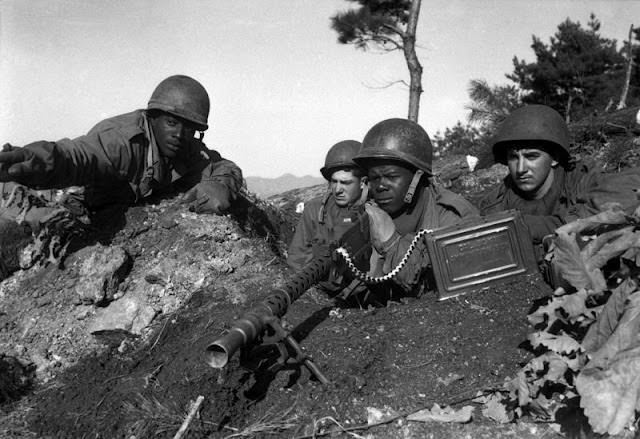
Pressed low behind a rough berm of earth and rock, soldiers of the U.S. 2nd Infantry Division work in tight formation near the Ch’ongch’on River during the Korean War in 1950. Steel helmets and heavy field jackets hint at the season’s bite, while the uneven ground and sparse trees frame a frontline position carved out of necessity. Faces are turned outward in concentrated watchfulness, the kind of stillness that comes when movement must be measured and every sound matters.
At the center, one man grips a handset connected by a coiled cord to a radio set, signaling how vital communications were for survival and coordination under fire. The equipment sits half-buried among dirt and debris, protected as best it can be in a shallow fighting position, suggesting the immediacy of combat conditions. Nearby, the outline of a weapon and other gear blends into the terrain, reinforcing the practical, improvised nature of battlefield life.
Moments like this offer a ground-level view of the Korean War beyond maps and headlines, emphasizing teamwork, discipline, and the constant need to balance concealment with readiness. For readers searching for Korean War history, U.S. Army 2nd Infantry Division photographs, or accounts of fighting around the Ch’ongch’on River, this scene provides an intimate visual record of soldiers adapting to harsh landscapes and uncertain orders. The result is a compelling reminder that the era’s major campaigns were made up of small, tense intervals like this—shared in silence, punctuated by radio calls, and defined by vigilance.