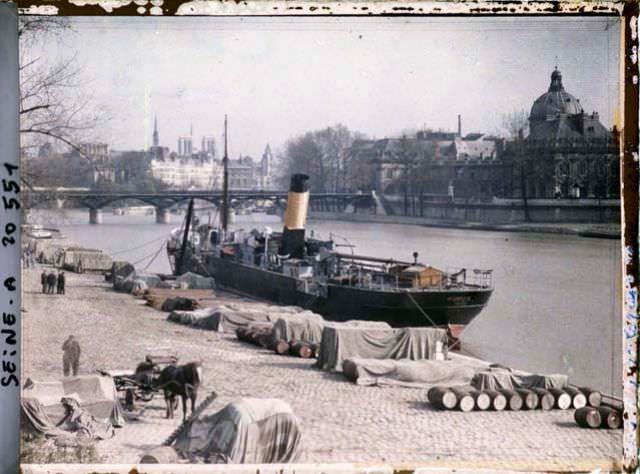
Along the Seine, a working riverfront stretches beneath Parisian bridges, where a moored steamship sits low in the water and barges crowd the quay. Tarps drape over stacks of goods and supplies, hinting at a steady rhythm of loading, unloading, and waiting, while the wide embankment doubles as a warehouse floor under open sky. In the distance, the city’s skyline rises in layered silhouettes—domes, towers, and rooftops softening into haze across the river.
Colorization brings a different kind of clarity to these early 1900s street scenes of Paris, translating textures—weathered stone, rippling water, and canvas coverings—into something newly legible to modern eyes. The river feels less like a postcard and more like infrastructure: a commercial artery feeding neighborhoods on both banks, with steam power and manual labor sharing the same frame. Even without captions, the details suggest how goods moved through the capital long before trucks and container ports took over the heavy lifting.
What makes this Paris photo compelling is its mix of grandeur and grit, where monumental architecture watches over the everyday commerce of the quays. The embankment reads like a snapshot of urban logistics in the Belle Époque era, and the colored treatment helps the scene breathe without stripping it of age. For anyone interested in Paris history, the Seine, or early 20th-century city life, this image offers a vivid, grounded look at how the famous city actually functioned.