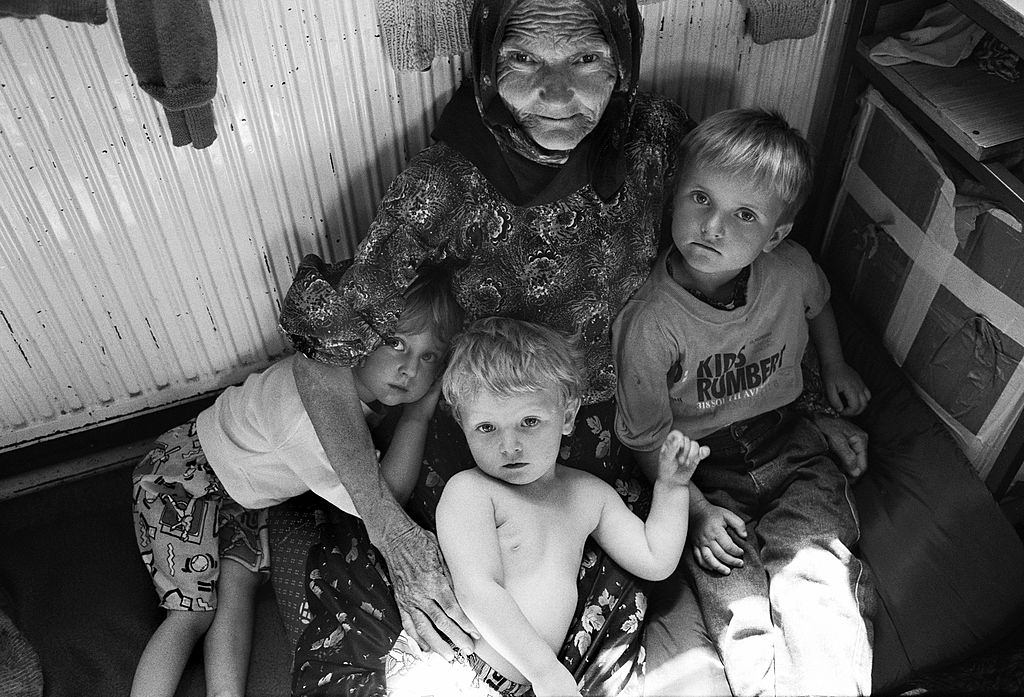
In a cramped corner of a refugee centre near Tuzla, an elderly Muslim grandmother gathers her young grandchildren into the safest shelter she can offer—her arms. The corrugated wall behind them and the tight arrangement of bodies speak of sudden displacement, while the children’s expressions range from wary to exhausted. Her face, lined with experience, holds a steady gaze that feels both protective and haunted by what has brought them here.
The title anchors the scene to the flight from the Srebrenica massacre, part of the brutal civil wars that tore through the former Yugoslavia and flooded aid stations with families who had lost homes, relatives, and any sense of certainty. Within that larger history, the photograph narrows down to the human scale: bare feet, rumpled clothing, a makeshift interior, and the quiet work of keeping children calm when the world outside has turned incomprehensible. It is the kind of moment that rarely appears in official accounts, yet it tells the story of survival as clearly as any headline.
For readers searching the history of Srebrenica, Tuzla, and Bosnian Muslim refugees, this image offers a direct, intimate record of civilian life under crisis. The grandmother’s embrace becomes a symbol of continuity amid rupture—family bonds holding fast when institutions fail and borders shift. Seen today, the photograph invites remembrance and reflection on how war’s legacy is carried not only in numbers and maps, but in the small, fiercely guarded spaces where the displaced try to endure.