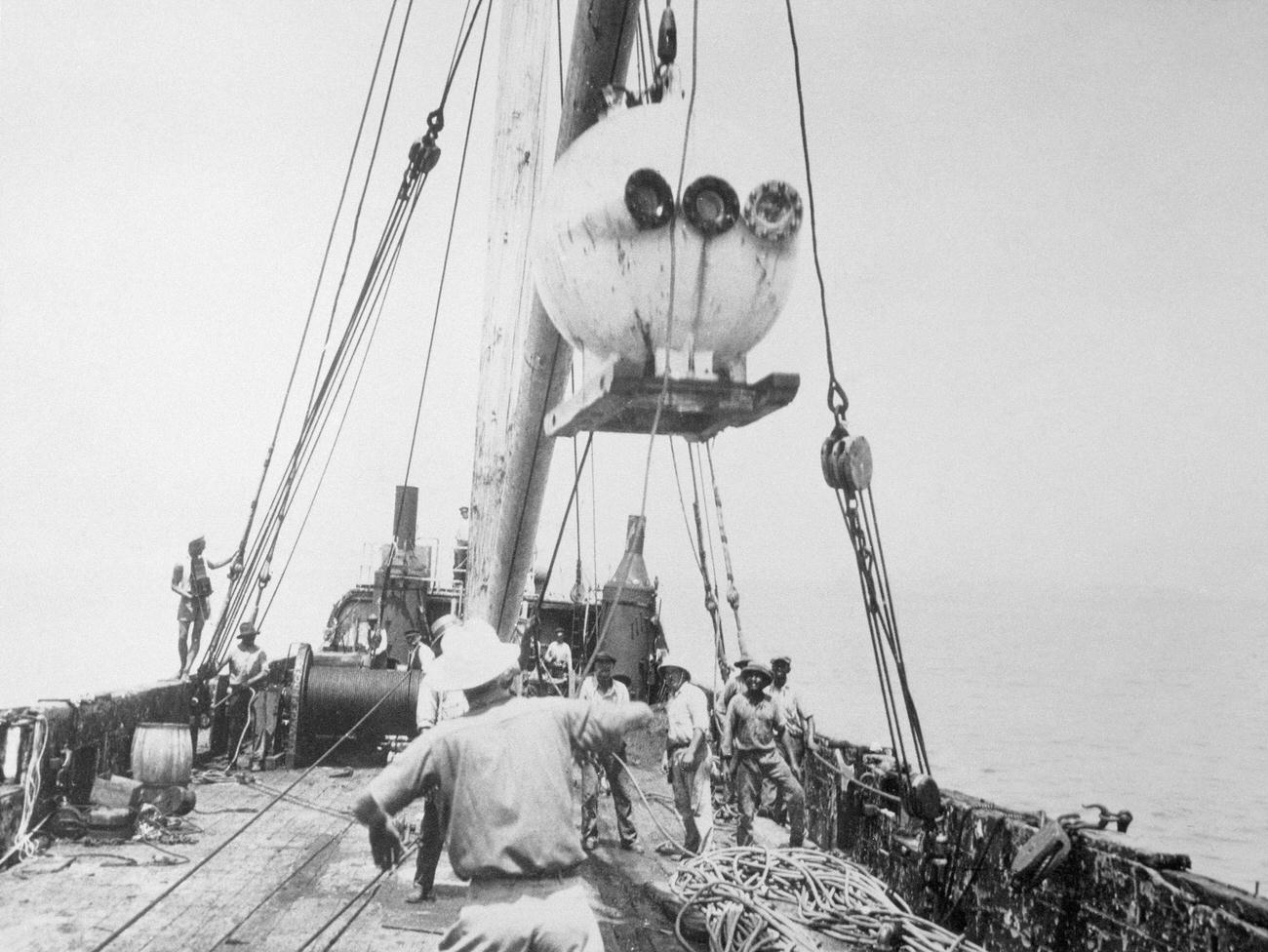
Suspended from a ship’s rigging like a strange metal fruit, the bathysphere hangs over the deck while crewmen brace, point, and wait for the next instruction. Its round body and porthole-like openings dominate the frame, a reminder that early undersea exploration depended as much on heavy engineering and seamanship as on scientific curiosity. Coils of rope, winches, and lines crisscross the scene, turning the working deck into a stage where invention meets risk.
William Beebe’s explorations off Nonsuch Island, Bermuda, are evoked here through the equipment and the coordinated labor surrounding it. Before submersibles became sleek and self-propelled, descent into the deep could mean being lowered in a compact sphere, tethered to the surface by cable and trust. The photo’s practical details—stained deck boards, taut rigging, and the careful handling of weight—bring the era’s experimental spirit into sharp focus.
For readers interested in the history of oceanography, diving technology, and pioneering scientific expeditions, this image offers a vivid entry point. It’s a powerful visual companion to discussions of the bathysphere as an invention that expanded humanity’s reach into the sea, and to Beebe’s role in making deep-sea observation part of modern science. Set against the open water near Bermuda, the scene underscores how discovery often begins not in a laboratory, but aboard a busy ship preparing to lower a bold idea into the unknown.