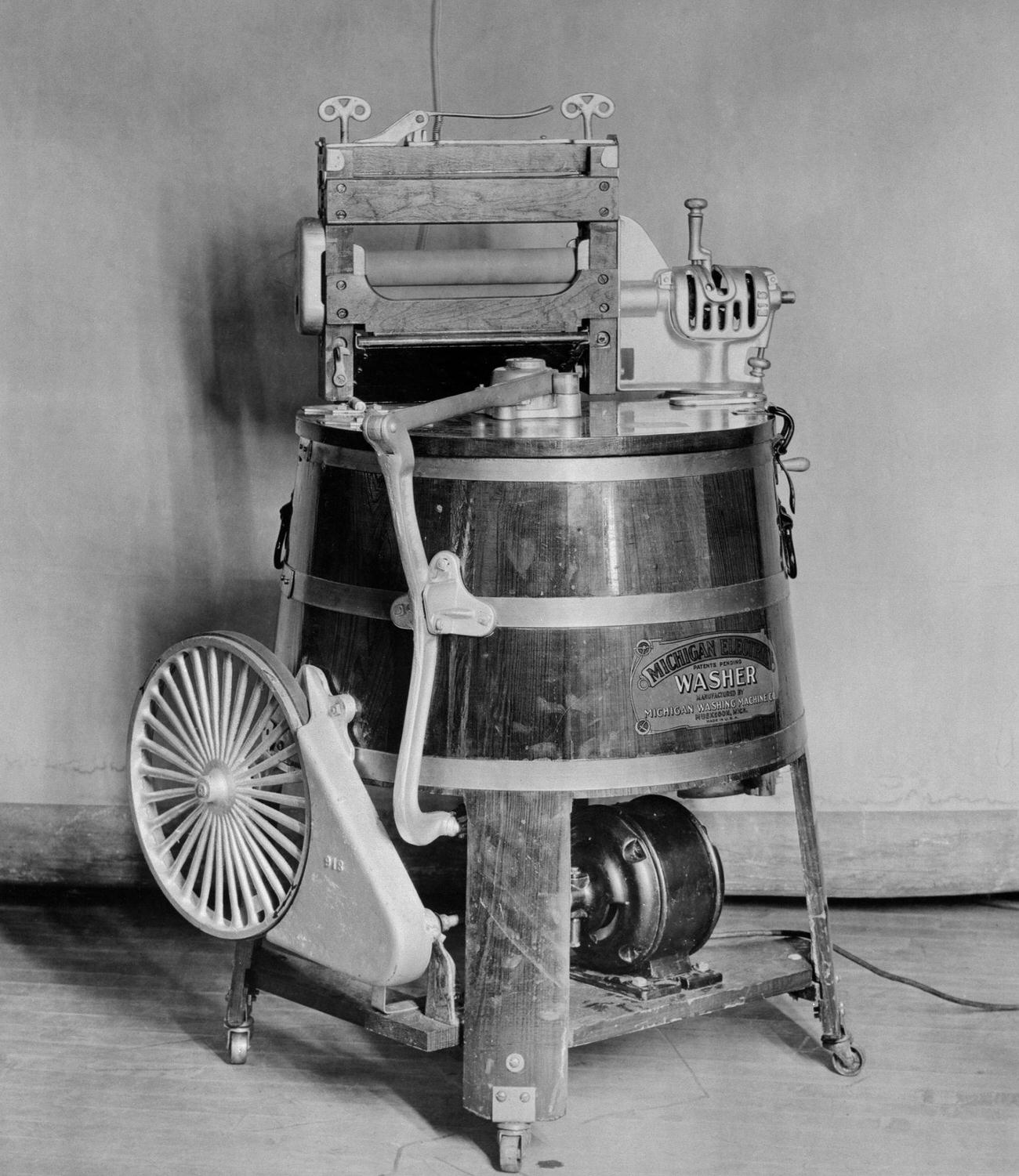
Industrial ingenuity sits in plain view here: a barrel-style electric washing machine branded “Michigan Washer,” its wooden tub bound with metal hoops and set on a sturdy frame with casters. The maker’s label reads Michigan Washing Machine Co., while the title points to a General Electric motor powering the mechanism. Every surface—wood grain, bolts, brackets, and fittings—speaks to an era when household appliances were built like shop machines and meant to be serviced rather than replaced.
What draws the eye is the hybrid of old and new technologies working together in one compact contraption. A prominent handwheel and linkage hint at earlier, human-powered laundry devices, yet the electric drive transforms that labor into steady, repetitive motion. Above the tub, the wringer assembly signals a time before automatic spin cycles, when squeezing water from cloth was a separate step—and a potentially hazardous one—integrated into the same station.
For readers exploring inventions and early home electrification, this photograph is a small window into changing domestic routines. Electric washing machines like this helped shift laundry from an all-day ordeal toward a mechanized process, reflecting both engineering advances and the growing reach of reliable electric motors in everyday life. The Michigan Washing Machine Company nameplate and the General Electric connection also make it a useful reference point for collectors, historians, and anyone researching the evolution of laundry technology and American appliance manufacturing.